

Table of Contents
- What Health Canada Guidelines for Insect Repellents Actually Require
- DEET Concentration Limits in Canada: What's Approved and Why
- Insect Repellent Safety for Children: Age Restrictions Parents Need to Know
- How to Apply Insect Repellent Safely: A Step-by-Step Guide
- Tick and Mosquito Protection: What Health Canada Says About Vector-Borne Disease
- Troubleshooting Adverse Reactions and Interactions with Other Topicals
- Frequently Asked Questions
Last Updated: September 13, 2026
What Health Canada Guidelines for Insect Repellents Actually Require
Health Canada guidelines for insect repellents are the rules that determine which products can legally be sold, what their labels must say, and how they may be marketed to consumers. This guide from TickFree Outdoors breaks down the requirements that matter most when you're choosing protection for a hike, a hunt, or a backyard evening.
Every insect repellent sold in this country must be registered before it reaches a shelf, whether that shelf is in a pharmacy or an online store. The Pest Management Regulatory Agency (PMRA), a branch of Health Canada, reviews each product's active ingredients, concentration, and label claims before granting a registration number. That number is your proof the product passed a safety assessment, not just a marketing department.
Here's the part most shoppers miss: registration isn't a formality. A product that fails review simply doesn't get sold, which is why you'll see familiar active ingredients like DEET and icaridin on approved labels and rarely see exotic botanicals making bold claims.
Registered Products vs. Unregistered Natural Sprays
A registered insect repellent carries a Pest Control Product (PCP) number on its label (canada.ca). An unregistered natural spray does not, and that absence tells you something important: no one has verified its effectiveness or its safety profile.
Many shoppers assume "natural" means "automatically approved." It doesn't. Health Canada requires the same evidence of efficacy and safety from a botanical product as from a synthetic one, and products that skip registration cannot legally make repellent claims. That's why a bottle of essential oil blend at a farmers' market may smell pleasant but carry no protection guarantee.
DEET Concentration Limits in Canada: What's Approved and Why
DEET concentration limits in Canada are capped by regulation, and the ceiling is lower than what you'll find on shelves south of the border. Products sold here generally top out at 30% DEET, a limit set because higher concentrations don't meaningfully extend protection and increase the risk of skin irritation and systemic absorption (canada.ca).
The logic behind the cap is straightforward. A 30% formulation already delivers hours of protection; pushing to 95% mostly adds dermal absorption risk without adding much duration. Icaridin, the other major active ingredient, typically appears at 20% and is often the better choice for sensitive skin because it feels lighter and doesn't damage plastics or synthetic fabrics the way DEET can.
| Active Ingredient | Typical Concentration | Protection Duration | Best For |
|---|---|---|---|
| DEET | Up to 30% | Several hours | Heavy wooded exposure |
| Icaridin | Around 20% | Several hours | Sensitive skin, gear-safe use |
| Oil of lemon eucalyptus | Varies by product | Shorter window | Mild, brief outings |
How to Read a Product Registration Number
A product registration number, printed as "PCP" followed by digits, appears on the label of every legal insect repellent. It's the fastest way to confirm a product passed Health Canada's safety assessment.
Look for it near the ingredients list or the manufacturer's information. If you can't find one, treat the product as unverified. This single check separates compliant products from hopeful ones, and it takes about five seconds.
Insect Repellent Safety for Children: Age Restrictions Parents Need to Know
Insect repellent safety for children hinges on age, and the guidance is more granular than most parents realize. Health Canada advises against using DEET-based repellents on infants under six months of age (canada.ca). For older children, the recommendation is to use the lowest effective concentration rather than reaching for the strongest product on the shelf.
The common mistake is treating a child's skin like a smaller version of an adult's. It isn't. Children have a higher surface-area-to-body-weight ratio, which means more dermal absorption per kilogram of body weight. Pediatric guidance exists precisely because that math changes the risk profile, not because regulators are being cautious for its own sake.
Age-Banded Guidance at a Glance
- Under 6 months: No DEET-based repellent. Rely on physical barriers, fine mesh over strollers and carriers, lightweight long sleeves, and timing outings away from dawn and dusk.
- 6 months to 2 years: DEET may be used at the lowest effective concentration, typically 10% or less, and only once per day. Icaridin is often preferred for this band because it is gentler on skin.
- 2 to 12 years: DEET up to 10% is generally appropriate, applied no more than three times daily. Icaridin around 10% to 20% is a common alternative.
- 12 years and older: Adult concentrations apply, including DEET up to 30% and icaridin around 20%.
These bands reflect the principle that concentration should match need, not exceed it. A 30% product on a toddler's arms is not more protective in any meaningful way, it simply increases exposure.
Product Form Matters More for Kids
Sprays are the hardest form to control on a child because drift reaches the face and eyes. Lotions and wipes give you far more precision. A practical approach: apply repellent to your own hands first, then wipe it onto your child's exposed skin. Skip the face entirely, or apply to your hands and dab carefully around the ears and jawline, avoiding the eyes, nostrils, and mouth.
Never let a child apply repellent themselves. The hands-to-mouth pathway is the single most common route to accidental ingestion in this age group, and children's hands end up near their faces constantly.
Reapplication and Wash-Off
Reapply only when protection fades, not on a fixed schedule, and never stack layers "just in case." When the outing ends, wash treated skin with soap and water. Treat clothing as a delivery system instead of skin: permethrin-treated outer layers and long sleeves reduce how often you need to touch a child's skin at all.
The Sunscreen Question
If you are using both sunscreen and repellent on a child, apply sunscreen first and let it dry, then repellent on top. Do not use a combined sunscreen-repellent product on children, because sunscreen needs frequent reapplication and repellent does not, you end up over-applying the repellent to keep the sun protection current.
How to Apply Insect Repellent Safely: A Step-by-Step Guide
Applying insect repellent safely comes down to coverage, timing, and restraint. Most people either under-apply and get bitten, or over-apply and irritate their skin. The middle path is simple once you know the sequence.
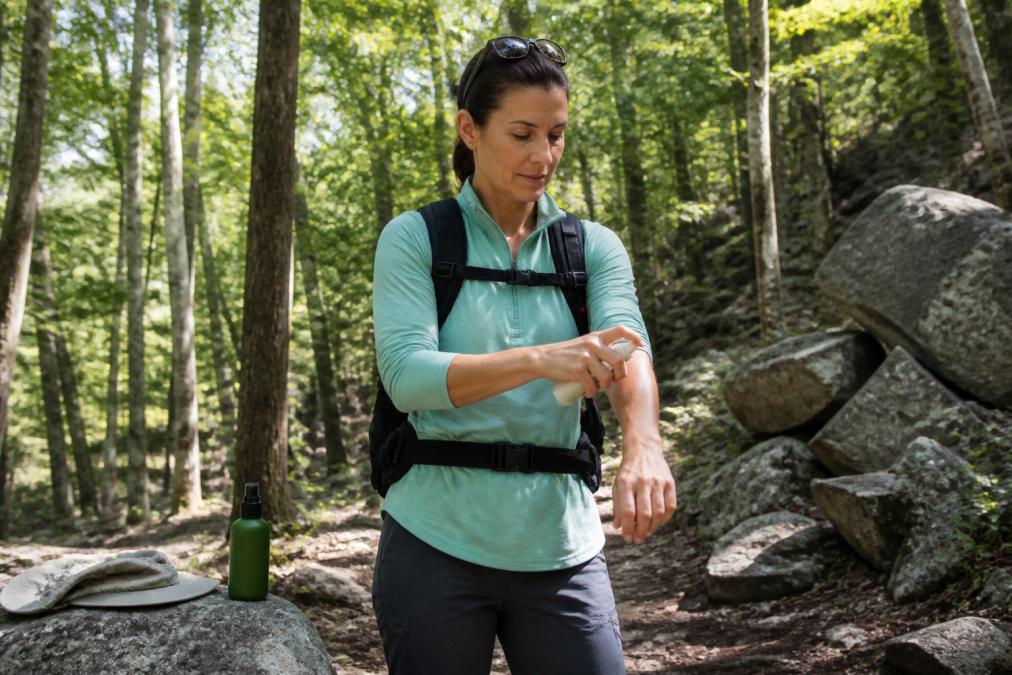
Follow these steps:
- Apply sunscreen first, then repellent, if you're using both.
- Spray onto exposed skin and clothing, not directly onto your face.
- Use just enough to cover, and avoid saturating the skin.
- Reapply only when protection fades, not on a fixed schedule.
- Wash treated skin with soap and water once you're back indoors.
Reapplication Intervals and Over-Application Risks
Reapplication intervals depend on the active ingredient and concentration, and the label tells you exactly what to follow. Over-application doesn't extend protection; it just increases exposure.
The real risk of over-application is dermal absorption and skin irritation, along with unnecessary systemic exposure. If you're sweating heavily or swimming, reapply sooner, but never stack layers "just in case."
Tick and Mosquito Protection: What Health Canada Says About Vector-Borne Disease
Tick and mosquito protection is about more than comfort. Health Canada tracks vector-borne disease across the country, and both West Nile virus and tick-borne illnesses like Lyme disease are the reason repellent guidance exists at all. The practical takeaway is that risk is seasonal and geographic, so the right protection depends on where you are and when.
Mosquito-Borne Risk: West Nile Virus
West Nile virus is transmitted by infected mosquitoes, and activity in most regions peaks from late summer into early fall. Mosquitoes are most active around dawn and dusk, so timing your outings and wearing protective clothing during those windows reduces bites before repellent even enters the picture. Standing water is the other lever: anything that holds water for more than a few days, clogged gutters, tarps, birdbaths, plant saucers, becomes a breeding site. Dumping it weekly cuts the local population at the source.
Tick-Borne Risk: Lyme Disease and Beyond
Lyme disease is transmitted by blacklegged ticks, and the risk is concentrated in specific regions rather than spread evenly. Ticks do not fly or jump; they quest, climbing to the tip of grass or brush and waiting to latch onto a passing host. That is why the guidance leans on repellent plus a full-body check after time in wooded or grassy areas, since tick-borne illnesses are transmitted through bites that often go unnoticed.
A proper tick check means more than a glance. Check warm, hidden areas: behind the knees, in the groin, under the arms, in and around the ears, inside the belly button, and along the hairline. Showering within a couple of hours of coming indoors helps wash off unattached ticks and makes them easier to find. If you find an attached tick, remove it promptly with fine-tipped tweezers, pulling straight up with steady pressure, and note the date.
The Layered-Protection System
Repellent is one layer of a system, not the whole system. The layers that matter most:
- Repellent on exposed skin, DEET or icaridin, applied per label.
- Permethrin-treated clothing, outer layers, socks, and boots. Permethrin kills ticks on contact rather than just repelling them, which is why it is the layer most people skip and most regret skipping.
- Physical barriers, long sleeves, long pants tucked into socks, and light-colored clothing that makes ticks easier to spot.
- Timed outings, avoid dawn and dusk mosquito peaks where practical.
- Post-outing checks, full-body tick check and a shower.
Regional Risk: Why One Product Does Not Fit All
Risk is not uniform. A backyard evening in a low-prevalence area may call for nothing more than a low-concentration repellent and long sleeves, while a hike through known tick habitat justifies permethrin-treated gear and a higher-concentration skin repellent. Matching concentration to actual local risk, rather than defaulting to the strongest product, is the principle that ties the whole system together.
Troubleshooting Adverse Reactions and Interactions with Other Topicals
Adverse reactions to insect repellent are usually mild: redness, itching, or a stinging sensation at the application site. Most resolve once the product is washed off, but knowing how to respond keeps a minor irritation from becoming a ruined trip.
The interaction question trips up more people than the reaction question. Applying repellent over sunscreen, moisturizer, or medicated creams can increase absorption of all of them. The safer sequence is sunscreen first, let it dry, then repellent on top. If you use a prescription topical, apply it separately and give it time to absorb before adding repellent.
If a reaction spreads, blisters, or comes with swelling beyond the application site, stop using the product and seek medical advice. Keep the label so you can identify the active ingredient and concentration.
Frequently Asked Questions
What is the maximum concentration of DEET allowed in Canada?
Health Canada permits DEET concentrations up to 30% in registered insect repellents. Products containing more than 30% DEET are not approved for sale. Lower concentrations, such as 5% to 10%, provide shorter protection windows and require more frequent reapplication. The concentration percentage directly affects how long the repellent remains effective, so matching the product to your outdoor exposure time matters more than choosing the highest number on the shelf.
Are natural insect repellents regulated by Health Canada?
Yes. Any product making insect repellent claims must be registered under the Pest Management Regulatory Agency, including those marketed as natural. Unregistered natural products sold without a product registration number have not undergone the safety assessment and effectiveness review that licensed products require. Before buying a botanical or essential-oil spray, check the label for a registration number. Without one, you cannot verify the product's claim of protection against arthropod-borne diseases.
How often should I reapply insect repellent according to safety guidelines?
Follow the reapplication intervals printed on the product label. Health Canada-approved products state specific durations based on their active ingredients and concentration percentage. DEET at 30% typically protects for about six hours, while lower concentrations last two to four hours. Icaridin-based products offer similar windows. Do not reapply more often than the label allows, because over-application increases dermal absorption and the risk of skin irritation or systemic toxicity.
Does Health Canada recommend specific repellents for tick protection?
Health Canada does not endorse brands, but it approves repellents containing DEET or icaridin for tick protection. Both active ingredients interfere with a tick's ability to detect a host. For tick-borne illnesses, the agency also stresses protective clothing, tucking pants into socks, and performing full-body checks after time in wooded or grassy areas. Repellent alone is not enough in high-risk habitats, especially during peak tick activity in spring and fall.
Choosing the right repellent is only half the battle. The other half is applying it correctly, respecting age limits, and layering it with protective clothing and post-outing tick checks. TickFree Outdoors carries sprays, repellent patches, and yard treatments built for exactly that system, with fast shipping, competitive prices, and premium customer service behind every order. Get started with TickFree Outdoors and build protection that holds up from the trailhead to the backyard.