

Table of Contents
- How Much Does Flea and Tick Prevention for Dogs Cost?
- Flea and Tick Prevention Cost Comparison at a Glance
- Prescription vs Over-the-Counter Flea Medication: Price and Efficacy
- Flea and Tick Treatment Frequency: Finding the Right Schedule
- Choosing the Best Tick Repellent for Dogs on a Budget
- Hidden Costs and Savings: Generic Brands, Insurance, and Autoship
- Conclusion
- Frequently Asked Questions
Last Updated: September 4, 2026
How Much Does Flea and Tick Prevention for Dogs Cost?
Flea and tick prevention for dogs cost is a common budgeting question, and the answer varies more than most expect. The total annual expense depends on the product type, whether it requires a prescription, and your dog's weight.
Focus on the annual cost projection, not the per-dose sticker price. A product that seems expensive upfront can cost less per month of protection than a cheaper-looking monthly pill.
Flea and Tick Prevention Cost Comparison at a Glance
The fastest way to compare costs is to look at the duration of protection each format delivers. Monthly chewables dominate the market, but they are not the only option, nor always the most economical.
| Product Type | Example Brand | Protection Duration | Typical Cost Model | Best For |
|---|---|---|---|---|
| Monthly Chewable | Simparica Trio | 1 month per dose | Per-pack pricing | All-in-one parasite protection |
| Extended Chewable | Bravecto Chews | 12 weeks per dose | Per-dose pricing | Owners who prefer fewer doses |
| Long-Term Collar | Seresto Collar | Up to 8 months | Per-unit pricing | Set-and-forget convenience |
| Multi-Parasite Chewable | NexGard PLUS | 1 month per dose | Per-pack pricing | Internal and external worm control |
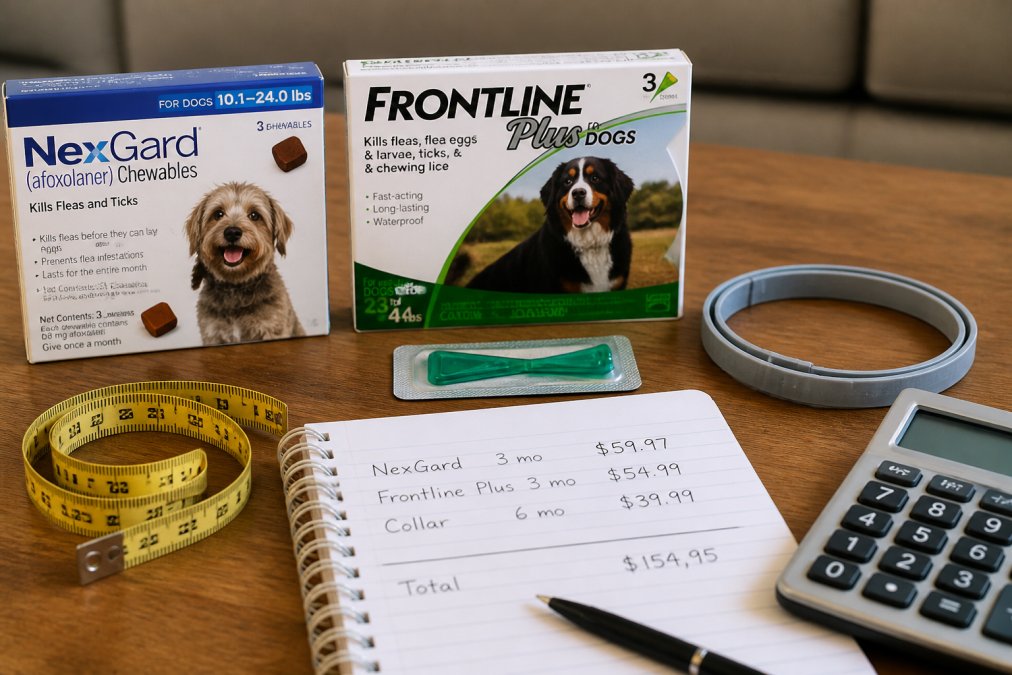
Projected across a full year, the differences become stark. A single dose of Bravecto Chews covers roughly three months, so most owners need only four doses annually. A monthly option like Simparica Trio requires twelve doses.
Prescription vs Over-the-Counter Flea Medication: Price and Efficacy
Prescription flea medication generally offers broader protection than over-the-counter options, but it comes with the added cost of a veterinary consultation (Canadian Veterinary Medical Association). Products like Simparica Trio and NexGard PLUS require a prescription because they contain active ingredients that also prevent heartworm disease and control internal parasites.
Prescription chewables provide systemic protection, circulating in the bloodstream and killing parasites when they bite. Many over-the-counter options, particularly older topicals, may only repel or kill on contact. In areas with heavy tick populations, the systemic approach is generally more reliable because it does not wash off or degrade with sun exposure.
The price gap between the two categories is real but narrower than most assume. Prescription medications cost more per dose, yet they often combine flea, tick, and heartworm prevention into a single product.
Flea and Tick Treatment Frequency: Finding the Right Schedule
Flea and tick treatment frequency is determined by the product's active ingredients and duration of efficacy, not the calendar month. Bravecto Chews provides 12 weeks of protection per dose, making a quarterly schedule sufficient (Product monograph for Bravecto Chews). Simparica Trio and NexGard PLUS are formulated for monthly administration, and the Seresto collar protects continuously for up to 8 months.
Many owners mistakenly assume all preventatives work on the same schedule. Switching from a monthly chewable to an extended-dose product without adjusting your calendar can leave your dog unprotected for weeks.
Align your dosing schedule with your dog's lifestyle and local tick season. Dogs that spend time in wooded areas or tall grass during warmer months may need year-round protection, while dogs that rarely leave the yard might be candidates for seasonal dosing.
Choosing the Best Tick Repellent for Dogs on a Budget
When budget is the primary constraint, the best tick repellent for dogs delivers reliable protection at the lowest annual cost, often pointing toward extended-duration formats. But the cheapest option is never the one with the lowest sticker price.
The True Annual Cost of Each Format
| Product Type | Example Brand | Protection Duration | Doses Needed Per Year | Typical Annual Cost Range | Best For |
|---|---|---|---|---|---|
| Monthly Chewable | Simparica Trio | 1 month per dose | 12 | $180-$300 | All-in-one parasite protection |
| Extended Chewable | Bravecto Chews | 12 weeks per dose | 4 | $160-$260 | Owners who prefer fewer doses |
| Long-Term Collar | Seresto Collar | Up to 8 months | 1-2 | $70-$140 | Set-and-forget convenience |
| Multi-Parasite Chewable | NexGard PLUS | 1 month per dose | 12 | $200-$320 | Internal and external worm control |
The Collar Option: Not Always the Bargain It Seems
The Seresto collar, with its 8-month protection window, requires fewer annual purchases than any monthly product, and its water-resistant design stays effective through swims and rain. At a typical retail price of $70-$100 per collar, the annual cost lands between $70 and $140, often half the cost of a monthly chewable.
However, the collar's lower price tag comes with trade-offs. Some dogs dislike wearing collars and will scratch at them constantly, leading to skin irritation or the collar being removed. While the collar repels and kills ticks on contact, it does not provide the systemic protection that oral medications offer.
The Oral Alternative: Fewer Doses, Same Protection
For owners who prefer oral administration, Bravecto Chews offers a middle ground: fewer doses per year than monthly chewables, with the same systemic protection. A single dose covers 12 weeks, so the annual cost is based on four doses rather than twelve.
The trade-off is that Bravecto Chews covers fleas and ticks but does not prevent heartworm disease. If you choose this product, you will need a separate heartworm preventative, which adds to the annual total.
The Decision Framework: What Actually Matters
The right budget choice depends on three variables: your dog's weight, your local tick species, and your dog's tolerance for different formats. A 10 kg dog on a monthly chewable will pay less than a 40 kg dog on the same product, because dosing is weight-based.
An over-the-counter topical that costs less per dose but fails to protect against the tick species in your region will cost far more in veterinary bills if your dog contracts a tick-borne illness. The cheapest annual cost is the one that covers everything your dog is actually exposed to.
When the Budget Is Truly Tight
If your budget cannot accommodate a prescription product, the best over-the-counter option is a topical treatment with a proven track record against the tick species in your area. These products are typically priced 30-50% below prescription chewables and do not require a veterinary visit.
A final consideration is whether your veterinarian offers a wellness plan that bundles preventatives into a monthly fee. Some clinics offer annual plans that include flea and tick medication, heartworm prevention, and a yearly exam for a single monthly payment.
Hidden Costs and Savings: Generic Brands, Insurance, and Autoship
The true cost extends beyond the product itself. Most owners overlook three major factors that can swing the annual total by hundreds of dollars: generic alternatives, insurance coverage, and subscription savings.
Generic vs. Name-Brand: A Cost-Benefit Breakdown
Generic versions of popular preventatives contain the same active ingredients as name-brand products but are often priced 20-40% lower. The key is verifying that the generic is veterinary-verified and approved by the appropriate regulatory body, such as Health Canada's Veterinary Drugs Directorate, before switching.
| Product Type | Name-Brand Example | Generic Equivalent | Typical Savings | Efficacy Consideration |
|---|---|---|---|---|
| Monthly Chewable | Simparica Trio | Generic sarolaner-based chewable | 20-30% per dose | Same active ingredient; verify the spectrum of protection matches |
| Topical Treatment | Frontline Plus | Generic fipronil + S-methoprene topical | 25-40% per dose | Same active ingredients; application method is identical |
| Extended Chewable | Bravecto Chews | Generic fluralaner chewable | 15-25% per dose | Same active ingredient; duration of protection should be confirmed |
The most important question is not whether the generic is cheaper, but whether it is equally effective. Most practitioners find that generics with identical active ingredients provide comparable protection.
Pet Insurance: What It Actually Covers
Pet insurance is another angle that most cost guides miss. Many comprehensive policies include preventative care as an optional add-on, which can reimburse a portion of your flea and tick medication expenses.
A common pattern is that insurance plans cover the cost of prescription preventatives but not over-the-counter products. Some plans reimburse a percentage of the cost, typically 50-80%, while others offer a fixed annual allowance for preventative care.
Subscription and Autoship Savings Strategies
Autoship programs offered by online pet pharmacies are the most straightforward way to reduce annual costs. Enrolling in a subscription typically unlocks a 5-15% discount on every shipment and eliminates the risk of forgetting a dose.
The savings multiply when you combine strategies. Many online retailers offer a free month of protection when you prepay for a full year, effectively reducing the cost of a 12-dose pack to 11 doses.
A less obvious strategy is to ask your veterinarian about price-matching. Many clinics now match online pharmacy prices to keep their clients from shopping elsewhere.
Regional price variations also play a role that owners rarely consider. The same chewable can differ in price between a big-box retailer, an independent pet store, and an online pharmacy, and shipping costs can erase the savings from a lower base price. Prices also fluctuate with local parasite prevalence; in regions with heavy tick seasons, demand drives prices up in spring and early summer, so buying a year's supply in advance can lock in a lower rate.
Conclusion
Protecting your dog from fleas and ticks is not a one-size-fits-all decision, and the cheapest product is rarely the most cost-effective one over a full year. The right choice balances your dog's weight, lifestyle, and tolerance for different formats against the total annual cost of protection.
At TickFree Outdoors, we understand that prevention extends beyond the medication your dog takes. Our premium sprays and yard treatments are designed to reduce the tick population in your outdoor spaces, complementing your dog's preventative care with an extra layer of defense. Get started with TickFree Outdoors and build a complete protection plan for every member of your family.
Frequently Asked Questions
Why is flea and tick medicine for dogs so expensive?
The cost reflects research, active ingredients, and veterinary oversight. Prescription options like Simparica Trio and NexGard PLUS undergo extensive efficacy and safety trials. These medications target the flea life cycle and kill ticks before they can transmit diseases like Lyme. The price also covers the convenience of a single, highly effective dose. Over-the-counter products may be cheaper, but they often lack the broad-spectrum protection and efficacy guarantees of their prescription counterparts.
Is it cheaper to buy flea and tick prevention in bulk?
Yes, buying in bulk is almost always cheaper. Most monthly preventatives are sold in 3, 6, or 12-month packs. The per-dose price drops significantly when you purchase a larger supply. For example, a 12-month supply of a chewable often costs less per dose than a single-month purchase. Check with your vet or a reputable online pharmacy for the best multi-dose pricing, and consider autoship programs for additional savings.
How does the cost of a long-lasting collar compare to monthly pills?
A long-lasting collar like Seresto has a higher upfront cost but can be more economical over time. Its price covers up to 8 months of continuous protection. When you compare that to the cumulative cost of a monthly chewable for the same period, the collar often comes out ahead, especially if you have a larger dog that requires a higher, more expensive dose. It also offers a 'set-and-forget' convenience.
Do I need a prescription for effective flea and tick prevention?
Not always, but a prescription is often required for the most effective options. Products like Simparica Trio and NexGard PLUS require a veterinary prescription. Over-the-counter treatments and collars can be effective, but they may not protect against as many tick species or internal parasites. A veterinary consultation ensures you choose a product suited to your dog's weight, health, and local parasite risks. For an added layer of protection, consider a repellent spray from TickFree Outdoors.
This article was written using GrandRanker