

Table of Contents
- Types of Tick Repellent for Dogs
-
Top Tick Repellent Products for Dogs
- 1. Bravecto Chews: 12-Week Oral Protection
- 2. Seresto Collar: 8-Month Continuous Defense
- 3. K9 Advantix II: Broad-Spectrum Topical Solution
- 4. NexGard Soft Chewables: Fast-Acting Monthly Protection
- 5. Frontline Plus: Multi-Stage Flea and Tick Control
- 6. AtlanTick Botanical Repellent: Natural Alternative
- How to Remove a Tick from a Dog
- Signs of Lyme Disease in Dogs
- Tick Season Duration and Peak Risk Periods
- How to Choose the Right Tick Repellent for Your Dog
- Conclusion
Last Updated: August 14, 2026
Types of Tick Repellent for Dogs
Tick repellents for dogs fall into four main categories, each with distinct advantages depending on your dog's lifestyle, health profile, and your preference for convenience versus natural ingredients.
Oral chewable tablets
Oral chewable tablets are among the most convenient tick repellent options available. These systemic medications are administered by mouth, typically once monthly or every three months, and work by entering your dog's bloodstream to kill parasites on contact. The primary advantage is simplicity, no application technique, water resistance concerns, or accidental contact with children or other pets. Most products kill fleas within 30 minutes and ticks within 12 hours, providing rapid protection against tick-borne disease transmission.
However, oral medications require a veterinary prescription and aren't suitable for puppies under 6-8 weeks of age or dogs with certain health conditions. Some dogs experience mild gastrointestinal upset, though this is relatively uncommon.
Topical spot-on treatments
Topical solutions, applied directly to the skin at the base of the neck, have been the gold standard for parasite prevention for over two decades. These liquid formulations spread across the dog's skin and coat, creating a protective barrier that kills and repels parasites before they can bite. Many formulations target not just ticks and fleas, but also mosquitoes, lice, and other biting insects. They're water-resistant once dry (typically within 24-48 hours), making them suitable for active dogs.
The trade-off is that topical treatments can be messy, and you must ensure the solution reaches the skin for full efficacy. In multi-pet households, you must keep treated dogs separated from cats until the product dries, as some formulations are toxic to felines.
Flea and tick collars
Modern flea and tick collars release active ingredients in a gas or vapor form, creating a protective zone around the dog's head and neck. Some newer collars provide up to 8 months of continuous protection, making them exceptionally convenient for owners who prefer minimal intervention. Collars excel in longevity and simplicity, once fitted, they require no monthly applications or veterinary visits for refills.
The limitation is that not all dogs accept a collar comfortably. Some experience localized skin irritation at the contact point, and puppies under 7-12 weeks may not be suitable candidates. The protective zone around the neck also means parasites on the hind legs or tail may receive less protection.
Natural and botanical options
Natural tick repellents derived from plant-based ingredients like lemon eucalyptus and cedar oil appeal to owners seeking chemical-free alternatives. These products are typically sprayed onto the dog's coat before outdoor activities and often have a pleasant scent compared to synthetic repellents.
However, botanical repellents provide shorter-duration protection, typically 4-6 hours at best. This means frequent reapplication during extended outdoor activities, which can become costly and inconvenient. They're best suited as supplementary protection or for occasional outdoor exposure rather than comprehensive tick prevention for dogs living in high-risk areas.
Top Tick Repellent Products for Dogs
1. Bravecto Chews: 12-Week Oral Protection
Bravecto delivers unmatched convenience with a single chew providing 12 weeks of continuous protection against fleas and ticks, meaning you only need to administer medication four times per year. It starts killing fleas within 2 hours and ticks within 12 hours, offering rapid protection against tick-borne disease. It's effective against black-legged ticks (the primary vector for Lyme disease), brown dog ticks, American dog ticks, and Asian longhorned ticks for the full 12-week period. For Lone Star ticks, protection extends to 8 weeks.
The beef-flavored tablet is palatable, and most dogs consume it readily. It can be given with or without food. The main consideration is that Bravecto requires a veterinary prescription and isn't suitable for puppies under 6 months of age or dogs weighing less than 4.4 pounds.
Best for: Owners who want maximum convenience and are willing to visit their veterinarian quarterly for prescriptions.
Pros:
- 12-week protection reduces dosing frequency to 4 times yearly
- Water-safe (no bathing restrictions)
- Rapid flea and tick kill times
- Palatable beef flavor
Cons:
- Requires veterinary prescription
- Not suitable for puppies under 6 months or dogs under 4.4 lbs
- Potential for mild gastrointestinal upset in sensitive dogs
2. Seresto Collar: 8-Month Continuous Defense
The Seresto collar provides 8 months of continuous protection, meaning most owners apply it twice per year, typically at the start of spring and fall tick seasons. This collar works through a combination of imidacloprid and flumethrin, active ingredients that create a protective gas zone around the dog's head and neck. The water-resistant design means your dog can swim, bathe, and play in wet conditions without losing protection. The collar is odorless and non-greasy, which appeals to many owners.
However, some dogs experience localized skin irritation at the collar contact site, particularly if fitted too tightly. Puppies under 7 weeks of age are not suitable candidates. Additionally, the protective zone centers around the neck, so parasites on the rear legs or tail may encounter less protection.
Best for: Owners seeking maximum convenience with minimal intervention. Ideal for dogs that tolerate collars well and spend regular time outdoors.
Pros:
- 8-month protection (apply twice yearly)
- Water-resistant design
- Odorless and non-greasy
- Kills and repels parasites on contact
Cons:
- Some dogs experience localized skin irritation
- Not suitable for puppies under 7 weeks
- Less protective on rear legs and tail
- Requires proper fit to avoid discomfort
3. K9 Advantix II: Broad-Spectrum Topical Solution
K9 Advantix II offers protection against a wider range of parasites than many competitors. Beyond fleas and ticks, it repels and kills mosquitoes, lice, and stable flies, making it an excellent choice for dogs in areas with high mosquito populations or those exposed to multiple biting insects. The topical solution is applied monthly to the dog's skin at the base of the neck, where it spreads across the coat and body. It kills fleas on contact within minutes and ticks within 12 hours.
The significant limitation is that K9 Advantix II contains permethrin, which is toxic to cats. This makes it unsuitable for multi-pet households where cats and dogs coexist. Topical application can also be messy, and you must keep treated dogs away from cats until the product dries completely.
Best for: Dogs in areas with high mosquito or biting fly populations. Single-dog households where cats are not present.
Pros:
- Broad-spectrum protection (ticks, fleas, mosquitoes, lice)
- Water-resistant after 3 days
- Fast-acting against multiple parasites
- Monthly application is convenient
Cons:
- Contains permethrin (toxic to cats)
- Topical application can be messy
- Not suitable for multi-pet households with cats
- Oily residue may be unpleasant for some owners
4. NexGard Soft Chewables: Fast-Acting Monthly Protection
NexGard chewables are beef-flavored tablets that kill fleas and ticks rapidly, starting to eliminate fleas within 30 minutes of administration. This fast action is particularly valuable if your dog has already been exposed to parasites and you want quick relief from itching and discomfort. The monthly chew is palatable for most dogs and can be given with or without food. It's effective against black-legged ticks (vectors for Lyme disease), brown dog ticks, and American dog ticks. The product is suitable for puppies 8 weeks of age and older.
NexGard's primary advantage is speed. If your dog has scratched or shown signs of flea or tick infestation, this product begins working within 30 minutes, providing rapid relief. The trade-off is that NexGard requires a veterinary prescription, and monthly administration is more frequent than some alternatives like Bravecto.
Best for: Owners seeking rapid flea and tick elimination and dogs that have already shown signs of infestation.
Pros:
- Starts killing fleas within 30 minutes
- Palatable beef flavor
- Can be given with or without food
- Suitable for puppies 8 weeks and older
Cons:
- Requires veterinary prescription
- Monthly dosing is more frequent than some alternatives
- Potential for mild gastrointestinal upset
- Not suitable for puppies under 8 weeks
5. Frontline Plus: Multi-Stage Flea and Tick Control
Frontline Plus targets all life stages of fleas, not just adults. The formulation kills adult fleas, flea eggs, larvae, and pupae, which makes it particularly effective at breaking the flea life cycle and preventing reinfestation. Applied monthly to the skin at the base of the neck, Frontline Plus becomes waterproof 24 hours after application. It controls brown dog ticks, American dog ticks, lone star ticks, and black-legged (deer) ticks, and also eliminates chewing lice infestations.
The multi-stage flea control is the standout feature. If your dog has experienced a flea infestation, Frontline Plus addresses not just the adult fleas causing immediate discomfort but also the eggs and larvae that would otherwise mature into new infestations.
Best for: Dogs with a history of flea infestation or those in areas with high flea populations.
Pros:
- Targets all flea life stages (eggs, larvae, pupae, adults)
- Effective against multiple tick species
- Waterproof after 24 hours
- Eliminates chewing lice
- Established brand with over 20 years of use
Cons:
- Requires monthly application
- Topical application can be messy
- Oily residue may be unpleasant
- Not suitable for cats
6. AtlanTick Botanical Repellent: Natural Alternative
AtlanTick Tick Attack is a plant-based spray formulated with lemon eucalyptus and other botanical extracts, offering a chemical-free tick repellent option for dogs and humans. The refreshing lemon eucalyptus scent is significantly more pleasant than synthetic chemical repellents. The spray provides up to 5 hours of tick protection and 6 hours of mosquito protection per application. It can be used on dogs, horses, and humans, making it versatile for multi-species households.
However, the shorter duration of effectiveness (5 hours) is a significant practical limitation. For dogs spending extended time outdoors, frequent reapplication becomes necessary. AtlanTick is best suited as supplementary protection for occasional outdoor exposure or as a complement to a longer-lasting systemic treatment.
Best for: Owners seeking natural, chemical-free options for occasional outdoor exposure. Dogs with sensitive skin or owners concerned about synthetic chemical exposure.
Pros:
- Natural, plant-based ingredients
- Pleasant lemon eucalyptus scent
- Safe for use on dogs, horses, and humans
- Environmentally friendly formula
Cons:
- Shorter duration (5 hours) requires frequent reapplication
- Less effective than chemical alternatives for extended outdoor exposure
- Higher cost per hour of protection due to frequent reapplication
- Better suited as supplementary rather than primary protection
How to Remove a Tick from a Dog
Removing a tick from a dog correctly is essential to prevent disease transmission and infection. The goal is to remove the entire tick, including the head and mouthparts, without crushing the tick's body or leaving fragments embedded in the skin.
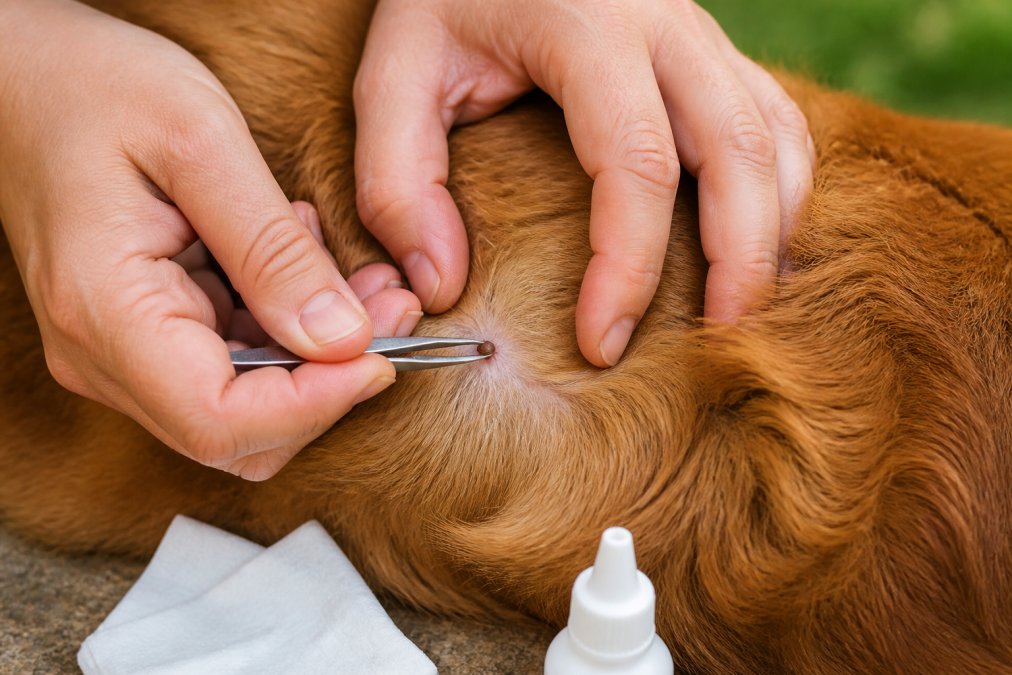
Step 1: Gather the right tools. Use fine-tipped tweezers or a tick removal tool designed for this purpose. Avoid using your bare fingers, as this can transmit disease. Do not use petroleum jelly, nail polish, or heat, as these methods can cause the tick to regurgitate infected fluids into the bite wound.
Step 2: Grasp the tick firmly. Position the tweezers as close to the dog's skin as possible, gripping the tick's head or mouthparts (not the swollen body).
Step 3: Pull straight out. Using steady, firm pressure, pull the tick straight out perpendicular to the skin. Do not twist or jerk, as this can cause the tick's body to separate from its head, leaving mouthparts embedded in the skin.
Step 4: Inspect the bite site. Once removed, examine the bite area to confirm the entire tick has been extracted. If you see a small black dot remaining, this is the tick's head; attempt removal again with tweezers.
Step 5: Dispose of the tick safely. Place the tick in a sealed container or bag, or flush it down the toilet. Do not crush it with your bare hands. If you're concerned about tick-borne disease, some regions offer tick testing services; contact your local public health authority for information.
Step 6: Clean the bite site. Wash the area with soap and water, then apply an antiseptic. Monitor the bite site for signs of infection over the following days.
Signs of Lyme Disease in Dogs
Lyme disease, transmitted by black-legged ticks infected with the bacterium Borrelia burgdorferi, can cause serious health complications in dogs if left untreated. Early signs typically appear 2-3 months after tick exposure. The most common sign is lameness or limping, often affecting one or more legs as the infection causes joint inflammation and pain. Affected dogs may be reluctant to walk, jump, or climb stairs, and the lameness may shift between legs.
Fever is another indicator, though it may not always be obvious to owners. Dogs with Lyme disease may appear lethargic, lose appetite, or show general malaise. Some dogs develop swollen joints, particularly in the knees and hocks, which may be warm or painful to the touch. In more severe cases, Lyme disease can progress to kidney disease (Lyme nephritis), which causes excessive thirst, frequent urination, vomiting, and weight loss.
The challenge with Lyme disease is that many infected dogs show no symptoms at all. Approximately 90% of dogs infected with Borrelia burgdorferi remain asymptomatic. For this reason, prevention through tick repellent is far more effective than relying on symptom recognition.
Tick Season Duration and Peak Risk Periods
Tick season in most regions spans spring through fall, though the exact timing and intensity vary by geographic location and climate.

In temperate regions, tick activity typically begins in late March or early April as temperatures consistently rise above 4°C. Activity peaks during late spring and early summer (May through July), when both adult and nymph-stage ticks are actively seeking hosts. A secondary peak often occurs in fall (September through October) as temperatures cool and ticks prepare for winter dormancy.
Black-legged ticks, the primary vector for Lyme disease, are active during this entire window, with nymphs (the smallest and most dangerous life stage) most prevalent in late spring and early summer. These tiny nymphs are difficult to detect on dogs, making them particularly concerning from a disease transmission perspective. Mild winters extend tick season in some regions.
The practical implication is that tick repellent for dogs should be applied year-round in regions where winter temperatures regularly exceed freezing, and at minimum from April through October in temperate areas.
How to Choose the Right Tick Repellent for Your Dog
Selecting the best tick repellent for your dog requires balancing several factors: your dog's age and health status, your lifestyle and outdoor exposure patterns, your preference for convenience versus natural ingredients, and your budget.
Assess your dog's lifestyle and exposure level. Dogs that spend significant time in wooded areas, tall grass, or near wildlife require stronger protection than dogs with primarily indoor lifestyles. If your dog hikes, camps, or spends hours outdoors daily, a long-lasting systemic treatment (oral tablet or collar) is more practical than a spray requiring frequent reapplication.
Consider your dog's age and health status. Puppies under 6-8 weeks cannot use most prescription treatments. Older dogs or those with liver or kidney disease may have restrictions on certain medications. Always consult your veterinarian about which products are safe for your specific dog.
Evaluate your tolerance for synthetic chemicals. If you're concerned about long-term exposure to permethrin, imidacloprid, or other synthetic active ingredients, botanical options like AtlanTick offer a chemical-free alternative. However, understand that natural products typically provide shorter-duration protection and require more frequent reapplication.
Factor in multi-pet household dynamics. If you have cats, avoid products containing permethrin (K9 Advantix II, Vectra 3D) or ensure treated dogs are kept completely separate from cats until the product dries. Oral treatments and collars are safer choices in multi-pet households.
Determine your convenience priorities. If you prefer minimal intervention, a collar providing 8 months of protection (Seresto) or an oral tablet lasting 12 weeks (Bravecto) reduces your workload significantly. If you prefer to administer treatment monthly, oral chewables (NexGard) or topical solutions (Frontline Plus, K9 Advantix II) offer more flexibility.
Compare cost over time. Calculate the annual cost of each option, not just the per-application price. A collar costing more upfront but lasting 8 months may be more economical than monthly applications over a year.
Start with your veterinarian's recommendation. Your vet knows your dog's health status, regional tick populations, and disease risks in your area. Their recommendation should be weighted heavily in your decision.
| Repellent Type | Duration | Convenience | Cost Range | Best For |
|---|---|---|---|---|
| Oral tablets (12-week) | 12 weeks | Very high | Pricing depends on quantity, dates, and delivery | Dogs tolerating chewables; minimal intervention |
| Oral tablets (monthly) | 30 days | High | Pricing depends on quantity, dates, and delivery | Fast-acting protection; dogs accepting chewables |
| Collar (8-month) | 8 months | Very high | Pricing depends on quantity, dates, and delivery | Maximum convenience; dogs tolerating collars |
| Topical spot-on | 30 days | Moderate | Pricing depends on quantity, dates, and delivery | Broad-spectrum protection; water-resistant needs |
| Botanical spray | 4-6 hours | Low | Pricing depends on quantity, dates, and delivery | Occasional exposure; chemical-free preference |
Conclusion
Protecting your dog from ticks is one of the most important preventative health measures you can take. Tick-borne diseases like Lyme disease carry real consequences, joint damage, kidney disease, and chronic pain, that could have been prevented with consistent repellent use.
The best tick repellent for your dog depends on your specific situation: your dog's age and health, your outdoor exposure patterns, your household dynamics, and your preferences for convenience and ingredient type. Bravecto offers unmatched convenience with 12-week protection. Seresto collars provide 8-month coverage for owners who prefer minimal intervention. Topical treatments like Frontline Plus and K9 Advantix II offer monthly flexibility and broad-spectrum protection. Natural options like AtlanTick appeal to owners seeking chemical-free alternatives, though with shorter-duration protection.
TickFree Outdoors provides comprehensive tick protection solutions across multiple formats, sprays, repellent patches, and yard treatments, designed to safeguard your dog, your family, and your outdoor environment. With fast worldwide shipping, great prices, and exceptional customer service, TickFree Outdoors makes it convenient to maintain year-round tick protection for all your outdoor adventures. [Consult with your veterinarian about tick-borne disease(/blogs/news/common-tickborne-diseases-and-how-to-prevent-them) risks in your region | canada.ca] to determine which repellent strategy is most appropriate for your dog's specific circumstances.
Frequently Asked Questions
What is the best tick repellent for dogs?
The best tick repellent for dogs depends on your dog's needs, lifestyle, and sensitivity. Oral chewables like Bravecto offer 12-week protection ideal for active dogs, while collars like Seresto provide 8 months of continuous defense. For topical solutions, K9 Advantix II protects against multiple parasites. Natural options like AtlanTick work for occasional exposure but require more frequent reapplication. Consult your veterinarian to match your dog's weight, age, and health profile with the most effective option.
How long does tick repellent for dogs actually last?
Duration varies significantly by product type. Oral tablets like Bravecto provide protection for 12 weeks, while monthly chewables like NexGard require monthly dosing. Topical treatments like K9 Advantix II and Frontline Plus last 4 weeks. Collars offer the longest protection: Seresto lasts 8 months and Scalibor lasts 3 months. Natural botanical sprays like AtlanTick typically last 5-6 hours and require frequent reapplication. Choose based on your dog's activity level and your ability to maintain a consistent schedule.
Are natural tick repellents effective for dogs?
Natural tick repellents like AtlanTick use botanical extracts and essential oils that repel ticks through scent and dermal absorption. They are safe for sensitive dogs and work well for occasional outdoor exposure. However, they typically last 5-6 hours compared to chemical treatments lasting weeks or months. Natural options are best used as supplementary protection or for light-exposure situations. For dogs in high-risk areas or those with frequent outdoor exposure, combining natural repellents with systemic medication provides more reliable protection against tick-borne disease transmission.
Can I use human tick repellent on my dog?
No, human tick repellents should not be applied directly to your dog. Products containing DEET or other human-grade formulations can be toxic to dogs if ingested during grooming. Dog-specific repellents are formulated for safe dermal absorption and lower toxicity risk. However, you can use human repellent on your own clothing, gear, and exposed skin while your dog wears pet-approved protection. This layered approach reduces environmental exposure for both you and your dog during outdoor activities in tick-prone areas.
This article was written using GrandRanker