

Table of Contents
- What Organic Tick Yard Treatment Actually Is (and Isn't)
- The Core Benefits of Organic Tick Yard Treatment
- How Organic Treatments Target Ticks at Each Life Stage
- How to Tick-Proof Your Yard Alongside Treatment
- Choosing a Pet-Safe Tick Yard Spray
- Best Tick Protection for Heavy Infestations
- Conclusion: Weighing the Real Benefits for Your Yard
- Frequently Asked Questions
Last Updated: September 10, 2026
What Organic Tick Yard Treatment Actually Is (and Isn't)
Organic tick yard treatment uses naturally derived or minimum-risk active ingredients to reduce tick populations on a residential property, rather than synthetic pyrethroid barrier sprays. This guide from TickFree Outdoors explains where those products work, where they fall short, and the real benefits of organic tick yard treatment for a yard bordered by woods.
Organic options control ticks well when paired with habitat work and applied on the right schedule, but they do not deliver the long residual knockdown of a synthetic barrier spray.
How Organic Treatments Differ From Synthetic Barrier Sprays
Synthetic barrier sprays rely on pyrethroids such as permethrin or bifenthrin, contact insecticides with residual efficacy persisting on vegetation for weeks, so applicators often treat only two or three times per season.
Organic products work differently. Most use botanical insecticides, cedar oil, rosemary oil, or similar plant-derived actives, often combined with soaps or oils that break down the tick's outer coating. They degrade faster in sunlight and rain, so application frequency rises.
What 'Minimum Risk' Means Under Health Canada Rules
Health Canada's Pest Management Regulatory Agency maintains a list of active ingredients it considers minimum risk, which allows certain botanical and food-grade products to reach the market with lighter registration requirements than conventional pesticides. The Health Canada Pest Management Regulatory Agency publishes the current list of permitted actives and the conditions attached to them.
Read that list before trusting a label. "Minimum risk" describes a regulatory pathway, not a guarantee of performance. A product can be legally sold as minimum risk and still be weak against nymphal stage ticks in tall grass.
The Core Benefits of Organic Tick Yard Treatment
The main benefits are reduced environmental toxicity, safety for pets and children, and no harmful effect on pollinators and other non-target species, advantages that matter most where kids and dogs use the same ground daily.
Safety for Pets, Children, and Pollinators
Synthetic pyrethroids are effective but not selective. They can affect bees and other beneficial insects, and pets should stay off treated lawns until dry. Botanical actives generally carry a shorter re-entry window, which is practical when your dog has free run of the yard.
"Natural" is not the same as "harmless." Essential oils can irritate skin and eyes, and some are toxic to cats in concentrated form, so store concentrates out of reach and follow the label dilution exactly.
Lower Environmental Toxicity and Soil Health Impact
Repeated synthetic applications can affect soil invertebrates and microbial activity, and runoff from treated hard surfaces can reach storm drains. Organic actives break down faster, limiting persistence in soil and reducing the load on nearby waterways.
Faster breakdown cuts both ways: a lighter ecological footprint, but shorter protection windows. Budget for reapplication after heavy rain.
Cost and Effort Over a Full Season
Per-application cost for a botanical spray tends to sit below a professional synthetic treatment, but you will apply more often. Over a full season the totals often land close together, and the deciding factor becomes your time rather than your money.
| Approach | Applications per Season | Residual Window | Best For |
|---|---|---|---|
| Organic botanical spray | More frequent | Short, rain-sensitive | Pet- and child-heavy yards |
| Synthetic barrier spray | Fewer | Longer | Heavy, established infestations |
| Habitat work alone | Ongoing | Permanent | Every property, always |
How Organic Treatments Target Ticks at Each Life Stage
Organic products hit ticks by contact, so timing matters more than concentration. The larval stage in late spring and the nymphal stage in early summer are the windows where a well-timed application does the most damage to tick density.
Adults in fall are the hardest and most important target, because adult blacklegged ticks overwinter and lay eggs. Treating only in spring leaves that population intact.
The Mechanism: How Botanical Actives Actually Kill Ticks
Most minimum-risk products do not work like a nerve-agent knockdown. They rely on one of three mechanisms:
- Desiccation and cuticle disruption. Soap and oil carriers break down the waxy outer layer of the tick's exoskeleton, causing it to lose water and die. Coverage, not concentration, drives results.
- Repellency and host-masking. Cedar oil, rosemary oil, and similar terpenes interfere with the tick's ability to detect carbon dioxide and host cues, so it drops off or fails to quest. This effect fades as the volatile compounds evaporate.
- Neurotoxic action at higher concentrations. Some botanical actives act on the tick nervous system, but at label rates the effect is slower than a pyrethroid and depends on the tick staying in contact long enough to absorb a lethal dose.
That difference explains the trade-off: organic products need thorough coverage of the exact micro-habitats ticks occupy, and reapplication once the volatile fraction has flashed off.
Temperature and Humidity Thresholds That Change Efficacy
Efficacy is not constant across the season:
- Below roughly 10°C, tick questing activity drops sharply and most botanical sprays are wasted, the ticks are not out where the spray lands.
- In the 15-25°C range with moderate humidity, both tick activity and product performance peak. Prioritize this window.
- Above roughly 30°C with low humidity, the volatile actives evaporate faster and the residual window shortens, so tighten reapplication intervals.
- After heavy rain, most minimum-risk products lose a meaningful share of their activity as actives wash off the leaf surface. Plan a reapplication rather than assuming the label interval still holds.
A north-facing slope with dense shade and damp leaf litter holds ticks long after a sunny front lawn dries out, so treat the two zones differently.
The Soil and Pollinator Angle Most Guides Skip
This is where organic treatments earn a genuine advantage synthetic barrier sprays cannot match. Pyrethroids are broad-spectrum and persistent; botanical actives break down faster, limiting persistence in soil and reducing the load on nearby waterways.
But "faster breakdown" is not automatically "pollinator-safe." A few caveats:
- Apply outside bloom. Spraying any contact product, organic or synthetic, onto flowering groundcover or shrubs in bloom exposes foraging bees directly. Timing matters more than the active ingredient.
- Avoid drift onto flowering weeds. Clover and dandelion are bee forage. Treating the whole lawn during bloom is the most common pollinator mistake homeowners make.
- Soil microbes recover faster after botanicals. Because actives degrade in days rather than weeks, disruption to soil fungal and bacterial communities is shorter-lived, a matter of degree, not a binary.
- Concentrates are not soil-safe by default. Spills and over-application of essential oil concentrates can still harm plants and soil life at the point of contact. Mix and store carefully.
Stage-by-Stage Application Calendar
- Larvae (late spring): treat leaf litter and shaded edges where eggs hatched. Focus on the duff layer, not open lawn.
- Nymphs (early summer): the highest-risk stage for lyme disease transmission, treat thoroughly and reapply after rain.
- Adults (fall): focus on wooded margins and areas where deer and rodents travel. This is the application that reduces next spring's population.
Host-targeted bait boxes and rodent treatments attack the same problem from the other direction by reducing the ticks that feed on mice and chipmunks. Used with a spray program, they suppress residential ticks more reliably than either method alone.
How to Tick-Proof Your Yard Alongside Treatment
No spray, organic or synthetic, fixes a yard that invites ticks back. Habitat modification keeps working after the product has degraded.
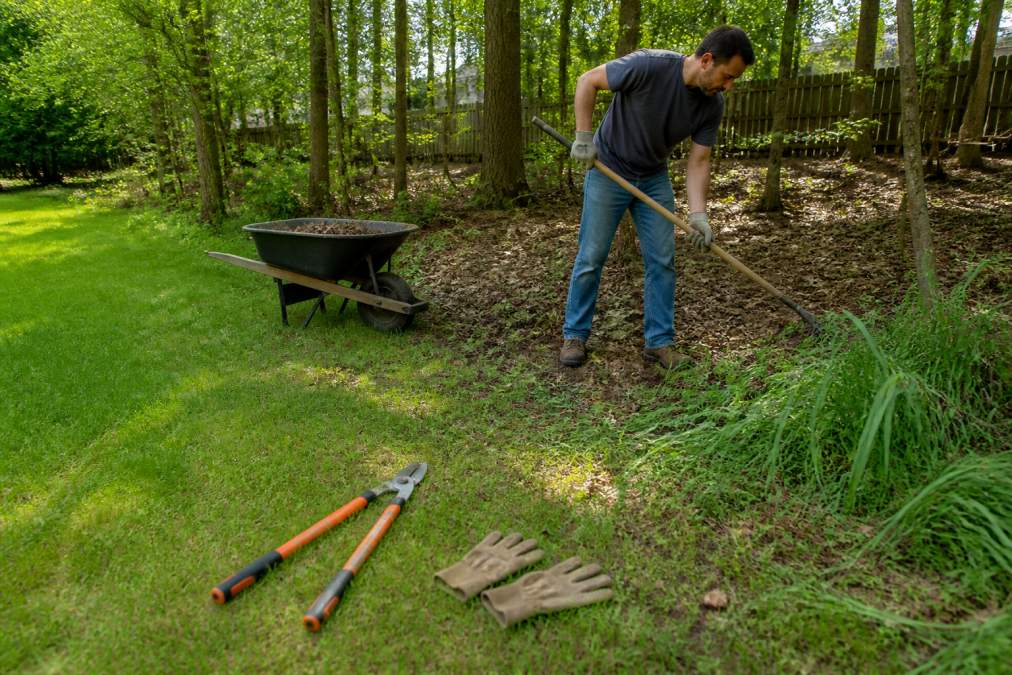
Start at the boundary between lawn and woods, where tick density peaks. Create a dry, sunlit strip of wood chips or gravel at least a meter wide between the two. Ticks dry out fast in open, unshaded ground, and this barrier is the highest-value landscaping modification you can make.
Then work through the rest:
- Clear leaf litter from beds, under shrubs, and along fence lines each fall and again in spring.
- Mow and edge regularly, keeping grass short at the perimeter.
- Prune low branches to let sunlight reach the ground.
- Move woodpiles and bird feeders away from the house and off the lawn.
- Keep stone walls tidy, since they shelter rodents that carry ticks.
Choosing a Pet-Safe Tick Yard Spray
A pet-safe tick yard spray is one whose label permits re-entry once dry, and whose active ingredients are not among the essential oils hazardous to cats. Check both before you buy.
Registered Pesticides vs. Minimum-Risk Exempt Products
This distinction matters for both safety and performance.
Health Canada's Pest Management Regulatory Agency (PMRA) maintains a list of active ingredients it considers minimum risk. Products built only from those actives can reach the market with lighter registration requirements than conventional pesticides. The Health Canada Pest Management Regulatory Agency publishes the current list of permitted actives and the conditions attached to them.
What that means in practice:
- "Minimum risk" is a regulatory pathway, not a performance claim. A product can be legally sold as minimum risk and still be weak against nymphal-stage ticks in tall grass.
- Registered conventional pesticides have undergone efficacy and toxicology review against PMRA standards. Minimum-risk products have not, which is why their label claims tend to be softer.
- Neither category is automatically safe for cats. Some minimum-risk actives, certain essential oils in particular, are hazardous to cats in concentrated form (aspca.org). Read the specific active, not the category.
Read the PMRA list before trusting a label, then read the ingredient panel: two products in the same regulatory category can have very different toxicity profiles.
A Cat-Safety Screen You Can Run in Two Minutes
- Identify every active ingredient on the label, not just the headline one.
- Cross-check each active against cat-safety guidance, concentrated essential oils are the usual problem.
- Confirm the label lists a re-entry interval after drying.
- Check whether the product is a concentrate or ready-to-use; concentrates carry higher spill risk.
- Match the product to your tick pressure, not the marketing copy.
Cost and Effort Over a Full Season
Per-application cost for a botanical spray tends to sit below a professional synthetic treatment, but you will apply more often. Over a full season the totals often land close together, and the deciding factor becomes your time rather than your money.
| Approach | Applications per Season | Residual Window | Best For |
|---|---|---|---|
| Organic botanical spray | More frequent | Short, rain-sensitive | Pet- and child-heavy yards |
| Synthetic barrier spray | Fewer | Longer | Heavy, established infestations |
| Habitat work alone | Ongoing | Permanent | Every property, always |
The hidden cost in the organic column is labor and reapplication timing. If you travel or cannot reapply after rain, the protection gap widens even though the per-bottle price looks lower.
Where a Full-Stack Supplier Fits
TickFree Outdoors offers yard treatments, repellent patches, and personal sprays. No botanical yard spray holds through a week of heavy rain, so plan reapplication around the forecast.
Best Tick Protection for Heavy Infestations
When tick pressure is high, organic alone often is not enough, and pretending otherwise puts people at risk. The best tick protection for heavy infestations layers approaches rather than picking one.
Build the stack in this order:
- Habitat modification first. It is permanent and costs nothing but labor.
- Host-targeted control second. Bait boxes and rodent management cut the reservoir of tick-borne pathogens.
- Spray third. Organic where safety is the priority, synthetic where knockdown is the priority, applied to edges and shade only.
- Personal protection always. Repellent patches, treated clothing, and a tick check after every outing.
Conclusion: Weighing the Real Benefits for Your Yard
The benefits of organic tick yard treatment are genuine but conditional. Lower environmental toxicity, safer ground for pets and children, and better outcomes for pollinators are worth having. They come with a shorter residual window and a heavier application schedule, and they only deliver results when habitat work and host-targeted control run alongside them.
If your priority is a yard your dog and kids can use without a chemical re-entry wait, TickFree Outdoors covers the full stack: yard treatments, pet protection, and personal repellents, backed by fast shipping and support that answers when something does not work. Get started with TickFree Outdoors and build a tick-safe yard from the ground up.
Frequently Asked Questions
Do organic tick yard treatments really work?
They reduce tick numbers, but results depend on the product and how you apply it. Botanical sprays using cedar oil or rosemary oil can knock down nymphal and larval ticks on contact, and residual efficacy typically lasts days to a few weeks depending on rain and sun exposure. For heavy infestations, combine organic spray with habitat modification and host-targeted control for the best outcome.
Is organic tick treatment safe for pets and children?
Products registered as minimum risk under Health Canada's Pest Control Products Act are generally considered lower risk for pets and children when used as directed. That said, keep kids and animals off treated areas until the spray dries, usually a few hours. Always read the label, and choose a pet-safe tick yard spray formulated for residential use rather than agricultural concentrates.
How often should I apply organic tick treatments to my lawn?
Most homeowners apply every 2 to 4 weeks through peak tick season, which in much of Canada runs from late spring through early fall. Application frequency depends on your product's residual efficacy, local tick density, and how much rain your yard gets. Treat the perimeter and shaded edges first, since blacklegged ticks concentrate there.
How does organic tick control compare to synthetic pesticides?
Synthetic pyrethroids and permethrin products often last longer per application and may kill ticks faster. Organic options break down quicker, which lowers environmental toxicity and non-target species exposure but means more frequent reapplication. Neither approach eliminates ticks alone; integrated pest management combining both strategies with landscaping modifications works best.
What kills ticks in the yard naturally?
Cedar oil, rosemary oil, and other botanical insecticides are common natural options. Beyond sprays, you can reduce tick density by removing leaf litter, mowing short, creating a gravel or mulch barrier between lawn and woods, and discouraging deer and rodents that carry tick-borne pathogens. Diatomaceous earth offers limited outdoor value once wet.
What is the best tick protection for heavy infestations?
Heavy infestations need layered control. Start with a barrier spray around your yard's perimeter, add host-targeted bait boxes to reduce ticks on rodents, and maintain landscaping modifications year-round. For personal protection in wooded areas, pair yard treatment with permethrin-treated clothing and repellent patches. Reapply botanical sprays more often when pressure is high.