

Table of Contents
- Quick Comparison: Best Tick Repellents for Heavy Exposure
- Why Permethrin Is Effective Against Ticks
- How to Apply Permethrin to Clothing
- Health Canada Approved Tick Repellents
- How to Apply Tick Repellent Correctly
- Repellent Longevity and Reapplication for Heavy Exposure
- Safety Precautions for Children, Pets, and Gear Compatibility
- Frequently Asked Questions
Last Updated: September 11, 2026
Quick Comparison: Best Tick Repellents for Heavy Exposure
The best tick repellent for heavy exposure combines a permethrin-treated layer of clothing with a high-concentration skin repellent, because ticks approach from low vegetation and climb upward before they bite. This dual-layer approach is what separates serious protection from a single spray bottle.
Here is how the leading options stack up for sustained outdoor work.
| Product | Active Ingredient | Best Use | Key Limitation |
|---|---|---|---|
| TickFree Outdoors spray + patch system | Permethrin and repellent actives | Full-body and gear coverage | Requires pre-treating clothing |
| Sawyer Premium Permethrin Fabric Treatment | 0.5% permethrin | Clothing, tents, gear | Never apply to skin |
| Ben's 100 | 98% DEET | Extreme tick density | Damages some plastics |
| OFF! Deep Woods | 25% DEET | General outdoor use | Strong scent |
| Sawyer Picaridin | 20% picaridin | Gear-safe skin protection | Shorter residual than DEET |
| Repel Lemon Eucalyptus | 30% oil of lemon eucalyptus | Plant-based preference | About 6 hours of protection |
Why Permethrin Is Effective Against Ticks
Permethrin is effective against ticks because it acts as a contact insecticide rather than a simple deterrent: ticks that crawl across treated fabric absorb it and die before they can attach. That distinction matters enormously in heavy exposure settings, where repellents that only discourage ticks leave you relying on constant vigilance.
Health authorities recognize permethrin as a clothing and gear treatment, not a skin product, and the Public Health Agency of Canada's tick bite prevention guidance frames treated clothing as a core layer of protection. The practical upside is durability. A properly treated garment keeps working for weeks and through several washings, so you are not reapplying every few hours in the field. For anyone spending long days in brush, that persistence is the whole point. The trade-off is preparation: you treat gear before you leave, not when the ticks are already on you.
How to Apply Permethrin to Clothing
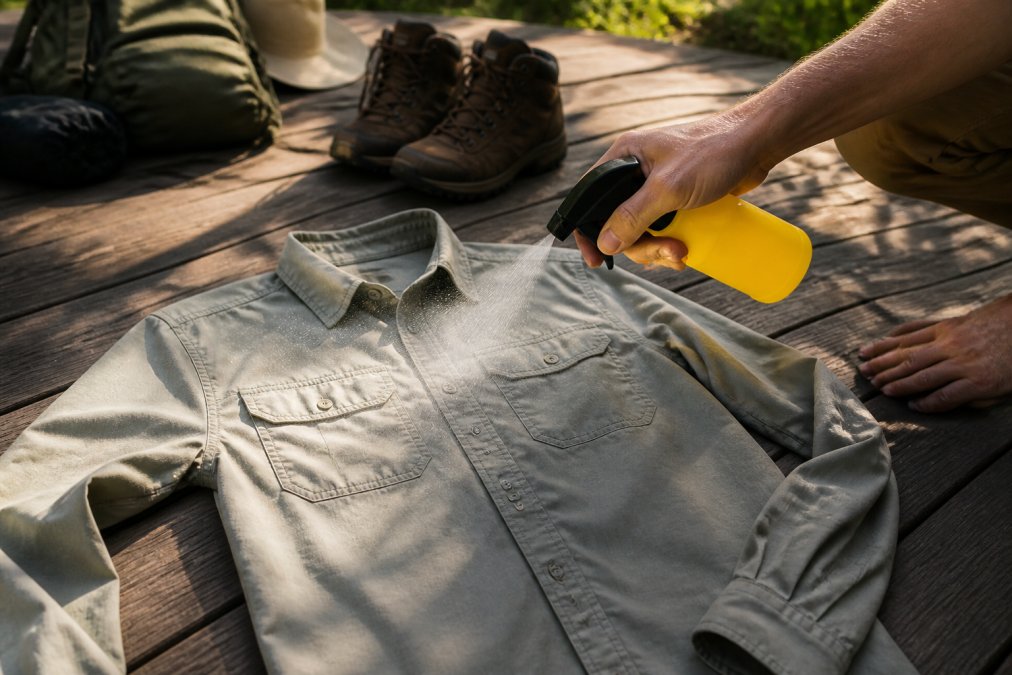
Apply permethrin by treating clean, dry clothing and gear outdoors in a ventilated area, then letting everything dry completely before wearing it. The steps below are the ones that actually matter for a durable, even treatment.
- Wash and dry the garments first so the treatment bonds to clean fabric.
- Hang items outside, away from pets and children.
- Hold the spray roughly 15 to 20 centimetres from the fabric and apply a slow, even pass.
- Pay extra attention to cuffs, collars, sock tops, and pant hems, where ticks make first contact.
- Let garments dry fully, usually a few hours, before packing or wearing them.
- Re-treat after the number of washings stated on the product label.
Health Canada Approved Tick Repellents
Health Canada approved tick repellents are those carrying a Pest Control Products Act registration number on the label, which confirms the product has been assessed for the claims it makes. That number is your fastest filter when comparing bottles on a shelf.
Registered actives for skin and clothing in this category include DEET, picaridin, and oil of lemon eucalyptus, alongside permethrin for fabric-only use. The Government of Canada pest control product label guidance explains how to read a registration number and why label directions are legally binding. A repellent that carries no registration number may still be sold as a "natural" product, but it has not been reviewed for tick efficacy. Check the label before you trust it with a long day in the woods.
How to Apply Tick Repellent Correctly
Apply skin repellent to exposed skin only, and apply it after you have put on your treated clothing, so you are not spraying over garments that already carry permethrin. Coverage gaps at the ankles, waist, and neckline are where most bites happen.
A workable order for a heavy exposure day:
- Dress in permethrin-treated base layers and socks.
- Apply your skin repellent to exposed skin, avoiding the eyes, mouth, and any broken skin.
- Spray your boots and the outer surface of your pack if the label permits it.
- Do a partner check at the trailhead, then again at the end of the day.
The Public Health Agency of Canada's Lyme disease surveillance data shows why the end-of-day check is not optional: tick-borne disease risk is tied to how long an attached tick stays on you, so prompt removal is part of the repellent strategy, not a separate task.
Repellent Longevity and Reapplication for Heavy Exposure
Repellent longevity is where most heavy-exposure plans fail, because people treat application as a morning task and then forget it. In practice, no single product covers a full day of brush work without attention, and the reason is mechanical: repellent sits on the surface of your skin, and everything that removes surface material removes protection.
Four forces drive how fast that happens:
- Sweat. Sweat physically washes actives off the skin and dilutes them at the surface. A high-output activity like trail building or a loaded ascent can cut effective duration well below the label figure.
- Humidity and rain. Water vapor and direct rain accelerate loss, especially for alcohol-based formulations that flash off quickly. A humid summer day in heavy cover is harder on a repellent than a dry one at the same temperature.
- Abrasion. Pack straps, brush, and clothing rub against treated skin. The ankles, waistline, and neck, the same spots where ticks make first contact, are also the spots that get rubbed most.
- Concentration and formulation. Higher concentrations of the same active generally extend duration, but the relationship is not linear, and a 98% DEET product does not last twice as long as a 50% one. Formulation (lotion vs. spray vs. controlled-release) matters as much as the number on the bottle.
A practical way to think about it: your clothing treatment is the long-duration layer, and your skin repellent is the short-duration layer that covers the gaps. Treat the clothing once per the label's wash count, and reapply skin repellent on a schedule tied to how hard you are working, not to the clock alone.
| Scenario | Skin Repellent | Clothing Treatment | Reapplication Trigger |
|---|---|---|---|
| Day hike, light cover | Standard DEET or picaridin | Optional | Once at end of day |
| Full day in heavy brush | High-concentration DEET or picaridin | Permethrin-treated layers | Every 2-3 hours, or after heavy sweating |
| Multi-day backcountry trip | High-concentration DEET | Permethrin, re-treat between trips | Morning, mid-day, and after any rain |
| Hot, humid, high-output work | High-concentration DEET | Permethrin-treated layers plus treated socks | Every 2 hours, sooner if soaked through |
This is the part most general guides skip. They list an active ingredient and a number of hours, and leave you to discover in the field that a humid climb through alder thickets burns through that estimate in half the time.
Safety Precautions for Children, Pets, and Gear Compatibility
Safety precautions differ sharply by user, and getting them wrong is the most common mistake we see. Children, pets, and your expensive synthetic gear each need a different approach, and the gear question in particular is where general guides stop short.
Children. Apply repellent to your own hands first and then to their skin, keeping it away from hands and faces so it does not end up in eyes or mouths. Do not apply to broken skin or under clothing. For infants, follow the product label and the guidance from your health care provider; many labels restrict use below a certain age.
Pets. Use only products labelled for animals. Never apply a human permethrin spray or a DEET product to a pet. Cats in particular are sensitive to permethrin, and a product that is safe on your hiking pants is not safe on a cat's coat. If you treat clothing or gear, keep pets away from the treated items while they dry and store treated gear out of reach.
Gear compatibility. This is the part that decides which bottle goes in your pack. DEET is an effective solvent for many plastics and some synthetic materials. Left on a watch crystal, a GPS housing, a camera body, or a technical shell, it can cloud, soften, or mar the surface. Picaridin and permethrin do not have the same effect on those materials, which is why a picaridin skin product is often the better pairing for someone carrying electronics and laminated fabrics. Permethrin, applied to fabric and allowed to dry, is the treatment layer; it is not a skin product and should never be sprayed on you.
A simple compatibility rule: if it has a plastic lens, a screen, or a laminated membrane, keep DEET off it and wash your hands after applying.
Sunscreen and layering. Heavy-exposure days are often sunny days, and the order matters. Apply sunscreen first, let it absorb, then apply repellent over it. Reapply sunscreen on its own schedule, repellent reapplication does not replace it. Some combination products exist, but separate application gives you more control over how much of each you are using, especially on children.
TickFree Outdoors offers premium sprays, repellent patches, and yard treatments to safeguard people, pets, and your home environment. If you are comparing options for a serious trip, browse the full range and match the product to your exposure level rather than the other way around.
Frequently Asked Questions
What is the most effective tick repellent for humans in Canada?
For heavy exposure, permethrin-treated clothing paired with a 20% picaridin or 98% DEET repellent on skin offers the strongest defense. Permethrin kills ticks on contact and lasts up to six weeks or six washings, while picaridin provides up to 12 hours of skin protection. Health Canada approved tick repellents include DEET, picaridin, IR3535, and Oil of Lemon Eucalyptus.
How does permethrin differ from DEET for tick protection?
Permethrin is applied to clothing and gear, not skin. It kills ticks on contact and remains effective through multiple washings, making it ideal for heavy exposure. DEET is applied to exposed skin and repels ticks, but it needs reapplication every few hours and can damage synthetic fabrics. Many outdoor professionals combine both for layered protection.
How often should I reapply tick repellent when working outdoors?
Reapply skin repellents every 4 to 8 hours depending on the active ingredient and sweating. Picaridin 20% lasts up to 12 hours, while lower DEET concentrations need reapplication every 4 to 6 hours. Permethrin-treated clothing does not need daily reapplication and stays effective for up to six weeks or six washings, which suits extended outdoor work.
Are natural tick repellents effective for high-risk areas?
Oil of Lemon Eucalyptus at 30% concentration provides up to 6 hours of tick protection and is the only plant-based ingredient recommended by health authorities. It works for moderate exposure but requires more frequent reapplication in heavy tick habitats. For extreme exposure, synthetic options like picaridin or permethrin-treated clothing offer longer-lasting reliability.
What clothing treatments are recommended for heavy tick exposure?
Permethrin spray treatments for clothing, boots, and gear are the standard for heavy exposure. Apply in a well-ventilated area, let garments dry completely, and expect protection for up to six weeks or six washings. Treat socks, pant cuffs, and shirt collars where ticks commonly attach. Never apply permethrin directly to skin.