

Table of Contents
- Quick Comparison: Blacklegged Tick vs Lone Star Tick
- Blacklegged Tick Identification: Size, Color, and Key Markings
- Lone Star Tick Identification: The White Spot That Sets It Apart
- How to Remove a Tick Safely: Step-by-Step
- Lyme Disease Symptoms in Canada and Other Tick-Borne Risks
- Using the eTick Identification Service for Confirmation
- Protecting Your Pets from Blacklegged and Lone Star Ticks
- Conclusion: Know the Difference, Act with Confidence
- Frequently Asked Questions
Last Updated: September 26, 2026
Quick Comparison: Blacklegged Tick vs Lone Star Tick
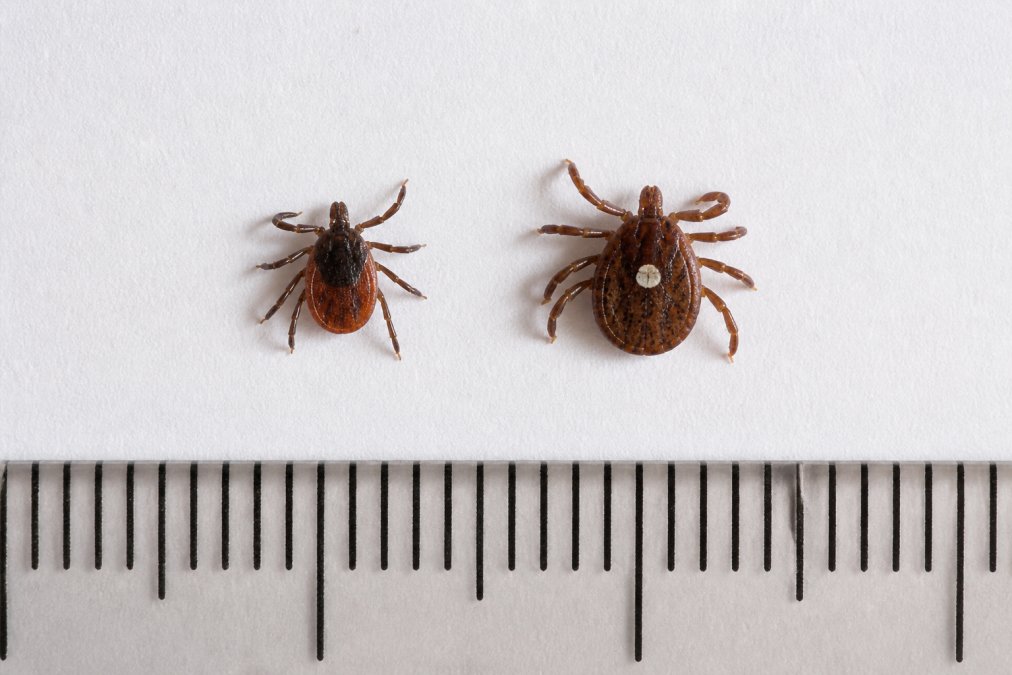
Tick identification in Canada comes down to three visual markers: the blacklegged tick has a solid black dorsal shield with no white markings, while the lone star tick carries a single white spot on its back.
| Feature | Blacklegged Tick | Lone Star Tick |
|---|---|---|
| Dorsal shield | Solid black, no markings | Brown with white spot (female) |
| Adult female size | 3-5 mm unfed | 4-6 mm unfed |
| Engorged appearance | Grey-brown, oval | Grey-brown, oval |
| White markings | None | Single white spot on female |
| Primary risk | Lyme disease, anaplasmosis | Alpha-gal syndrome, ehrlichiosis |
| Established range | Eastern and central regions | Rare, mostly travel-related |
Blacklegged Tick Identification: Size, Color, and Key Markings
The blacklegged tick (Ixodes scapularis) is the species you're most likely to encounter in established risk areas. Adults are active in spring and fall; nymphs peak in late spring and summer.
Adult Female Blacklegged Tick
Adult females are the easiest to spot and the most important to identify. They measure roughly 3-5 mm unfed, with a reddish-orange body and a solid black dorsal shield covering the front third of the back, no white markings anywhere. Engorged, the body swells to a grey-brown oval up to 10 mm, but the black shield stays visible at the front.
Adult Male and Nymphal Stage Blacklegged Tick
Males are smaller, entirely dark brown to black, with the shield covering the whole back, and rarely bite. The nymphal stage is the real concern: poppy-seed sized, roughly 1-2 mm, tan-coloured, and easy to miss. Most Lyme disease transmission in Canada traces back to nymph bites, which go unnoticed for the 24-plus hours Borrelia burgdorferi needs to transfer.
Lone Star Tick Identification: The White Spot That Sets It Apart
The lone star tick (Amblyomma americanum) is identified by a single white spot on the back of the adult female, unique among ticks found in Canada, and the fastest way to rule the species in or out.
Adult Female Lone Star Tick
Females are reddish-brown with a distinctive white spot near the centre of the dorsal shield, slightly larger than blacklegged females at around 4-6 mm unfed, with noticeably longer mouthparts. The white spot stays visible even when partially engorged.
Adult Male and Larval Lone Star Tick
Males have white markings around the outer edge of the body rather than a single central spot. Larvae are tiny, six-legged, and nearly impossible to identify without magnification. Lone star ticks are not considered established in most of Canada, so a confirmed sighting usually means recent travel to an endemic area in the United States or a rare imported case.
How to Remove a Tick Safely: Step-by-Step
Safe removal is mechanical, not chemical. No petroleum jelly, no nail polish, no burning. Those methods irritate the tick and increase the chance it regurgitates into the bite.
- Grasp the tick with fine-tipped tweezers as close to the skin as possible.
- Pull straight up with steady, even pressure. Do not twist or jerk.
- Check that the mouthparts came out with the body. If not, leave them and let the skin heal.
- Clean the bite area and your hands with antiseptic or soap and water.
- Save the tick in a sealed container or take a clear photo for identification.
- Note the date and location of the bite in case symptoms appear.
Lyme Disease Symptoms in Canada and Other Tick-Borne Risks
Because the two ticks carry different pathogens, the first useful question after a bite is not "do I have symptoms?" but "which symptom pattern am I watching for?"
| Blacklegged tick bite | Lone star tick bite | |
|---|---|---|
| Pathogens of concern | Borrelia burgdorferi (Lyme disease), Anaplasma phagocytophilum (anaplasmosis), Babesia species (babesiosis) | Ehrlichia species (ehrlichiosis), Francisella tularensis (tularemia), and the alpha-gal sugar linked to red-meat allergy |
| Typical onset | 3-30 days after the bite | Ehrlichiosis often 1-2 weeks; alpha-gal reactions are delayed, commonly 2-6 hours after eating red meat |
| Signature early sign | Expanding rash at the bite site (erythema migrans), though not everyone develops one | No rash at the bite site; instead, hives, itching, or swelling hours after a meal of beef, pork, lamb, or venison |
| Common early symptoms | Fever, fatigue, headache, muscle and joint aches, swollen lymph nodes | Fever, headache, fatigue, muscle aches, nausea, sometimes confusion in ehrlichiosis |
| What makes it easy to miss | The rash can appear anywhere on the body, not just at the bite, and can be faint | The reaction is tied to a meal, not the bite, so the tick connection is rarely made |
| When to seek care | Any expanding rash, or fever and aches within a month of a bite in a risk area | Fever after a bite, or repeated hives and digestive upset after eating red meat |
Why the distinction changes what you do next
If you identified a blacklegged tick, the clock that matters is attachment time. Borrelia burgdorferi generally needs the tick attached for roughly 24 hours or more before transmission becomes likely, which is why same-day removal is so effective and why an unnoticed nymph is the higher-risk scenario.
The overlap that trips people up
Fever, headache, fatigue, and muscle aches appear on both sides of that table, which is why identification matters before you decide what to monitor. A blacklegged tick bite with fever points toward Lyme disease and anaplasmosis testing; a lone star tick bite with fever points toward ehrlichiosis.
What to bring to a healthcare provider
- The date of the bite, or your best estimate if you found an attached tick.
- The location where you likely picked it up.
- Any identification you confirmed, including a photo or the saved tick.
- The symptom timeline, especially whether symptoms followed a meal or a bite.
If you develop symptoms after a tick bite, contact a healthcare provider and mention the bite, the date, and any identification you managed to confirm. The Government of Canada tick-borne disease guidance outlines the notifiable disease reporting framework and provincial resources for follow-up.
Using the eTick Identification Service for Confirmation
The eTick platform is a free image-based identification service that lets you submit a photo of a tick and receive expert confirmation of the species. It's run as a public surveillance tool, so your submission also contributes to national population mapping.
Here's how to get a usable photo:
- Place the tick on a plain white surface with good lighting.
- Photograph from directly above so the dorsal shield is fully visible.
- Include a ruler or coin in the frame for scale.
- Submit the image with the date and location where the tick was found.
Protecting Your Pets from Blacklegged and Lone Star Ticks
Dogs and cats pick up ticks in the same habitats people do, and their coats hide attached ticks far longer than a human skin check would. Here's how to identify each species on an animal, where to look, and what changes when the host has fur.
Identifying a blacklegged tick on a pet
On a dog or cat, the blacklegged tick is usually found as an adult female or a nymph.
- Adult female: reddish-orange body with a solid black shield on the front third of the back. No white markings. Unfed, roughly 3-5 mm, about the size of a sesame seed.
- Adult male: smaller and entirely dark brown to black, with the shield covering the whole back. Rarely attaches and feeds.
- Nymph: poppy-seed sized, roughly 1-2 mm, tan to translucent, the stage most likely to be missed on a pet and most associated with Lyme disease transmission.
- Engorged: swells to a grey-brown oval up to about 10 mm, but the black shield stays visible at the front, the giveaway even on a fully fed tick.
Identifying a lone star tick on a pet
- Adult female: reddish-brown with a single white spot near the center of the dorsal shield, visible even when partially engorged, which makes it identifiable on a pet after feeding has started.
- Adult male: white markings around the outer edge of the body rather than one central spot.
- Larva: tiny, six-legged, and nearly impossible to identify without magnification. Lone star larvae can appear in clusters, so several tiny ticks in one spot is worth a closer look.
- Mouthparts: noticeably longer than the blacklegged tick's, which means a slightly different removal feel, but the technique does not change.
Where to check on a dog or cat
A common mistake is checking only the ears and neck. Ticks also favor the armpits, groin, between the toes, under the collar line, around the eyelids, and along the tail base. On long-haired pets, run your fingers against the grain over the whole body, an attached tick feels like a small, firm bump that does not move with the skin.
What changes when the host has fur
- Grooming hides evidence. Pets lick and scratch bite sites, so the local irritation you would notice on yourself may never appear.
- Engorgement happens fast. A tick can feed for days on a pet before it is found, so daily checks matter more than weekly ones during active season.
- Species confirmation still matters. A lone star tick on a pet is a travel or import signal, not a local population. A blacklegged tick means you are in a Lyme disease risk area, note the date.
- Save the tick. A sealed container or clear photo submitted for expert review beats a verbal description for your veterinarian.
Practical protection for pets and people
- Check pets after every walk in wooded or grassy areas, year-round in mild regions.
- Keep lawns mowed short and clear leaf litter near the house edge.
- Use a repellent labeled for the species you're targeting and the animal in question. Never apply a dog product to a cat.
- Treat clothing and gear before heading into known tick habitat.
- Shower within two hours of coming indoors and do a full body check.
For pet owners managing repeat exposure, the right combination of yard treatment and on-animal protection does most of the work. TickFree Outdoors offers sprays, repellent patches, and yard treatments designed for people, pets, and the spaces between them, with fast shipping, great prices, and exceptional customer service.
Conclusion: Know the Difference, Act with Confidence
The blacklegged tick and the lone star tick look similar at a glance, but the white spot, the dorsal shield, and the size difference settle the question fast. Getting identification right tells you which diseases to watch for and how urgently to act.
Frequently Asked Questions
How can I tell if I was bitten by a lone star tick?
A lone star tick bite often leaves an itchy red mark, but the best way to know is to identify the tick itself. Adult females have a distinctive white spot on their back. If you develop a rash or flu-like symptoms, see a healthcare provider. You can also submit a photo to the eTick identification service for expert verification.
Can the lone star tick be found in Canada?
Yes, lone star ticks have been found in Canada, but they are not considered established in most regions. They are typically brought in by migratory birds or travelers. The blacklegged tick, however, is well established in many parts of Canada and is the primary carrier of Lyme disease.
What are the physical differences between a blacklegged tick and a lone star tick?
Blacklegged ticks are smaller, with a reddish-brown body and black legs. Adult females have a red abdomen and black dorsal shield. Lone star ticks are larger and reddish-brown, with adult females featuring a single white spot on their back. Lone star ticks also have longer mouthparts and a teardrop-shaped body.
Which tick species in Canada carries Lyme disease?
The blacklegged tick (Ixodes scapularis) and the western blacklegged tick (Ixodes pacificus) are the primary carriers of Lyme disease in Canada. They transmit the bacterium Borrelia burgdorferi. Lone star ticks are not known to transmit Lyme disease but can carry other pathogens.
What should I do if I find a tick on my body?
Remove the tick promptly using fine-tipped tweezers. Grasp the tick as close to the skin as possible and pull upward with steady pressure. Clean the bite area with rubbing alcohol or soap and water. Save the tick for identification, and monitor for symptoms like rash or fever. If symptoms appear, contact a healthcare provider.