

Table of Contents
- Does Tick Repellent Expire and Become Ineffective?
- How to Store Insect Repellent to Extend Its Shelf Life
- Signs of Expired Bug Spray: Smell, Color, and Consistency
- Active Ingredients and Their Shelf Life: DEET, Picaridin, and Natural Options
- Risks of Using Expired Tick Repellent and How to Test Potency at Home
- Proper Disposal of Expired Pesticides: Environmental Impact and Safe Methods
- Protecting Yourself from Tick-Borne Illness with Fresh Repellent
- Frequently Asked Questions
Last Updated: September 16, 2026
Does Tick Repellent Expire and Become Ineffective?
Yes, tick repellent expires, and yes, it becomes less effective over time. That matters more than most people realize, because a repellent that has lost its potency doesn't announce itself. It still smells like repellent. It still sprays. It just stops doing the one job you bought it for.
This guide breaks down how to tell whether your tick repellent expire date has passed, how to store insect repellent so it lasts, and what to do with the bottle you no longer trust. The stakes are real: Health Canada's guidance on Lyme disease and other tick-borne illnesses notes that tick-borne illness cases have been rising across many regions, and a failed repellent puts you directly in the path of that risk.
Here's the part most guides get wrong: they treat the printed date as the whole story. It isn't. Storage conditions, formulation type, and active ingredient all determine whether your spray is still working long before or after that number.
How to Store Insect Repellent to Extend Its Shelf Life
Store tick repellent in a cool, dark, dry place with the cap sealed tight, and it will hold its potency far longer than a bottle left on a sunny windowsill or in a hot car. Heat, light, and air are the three things that break a formulation down.
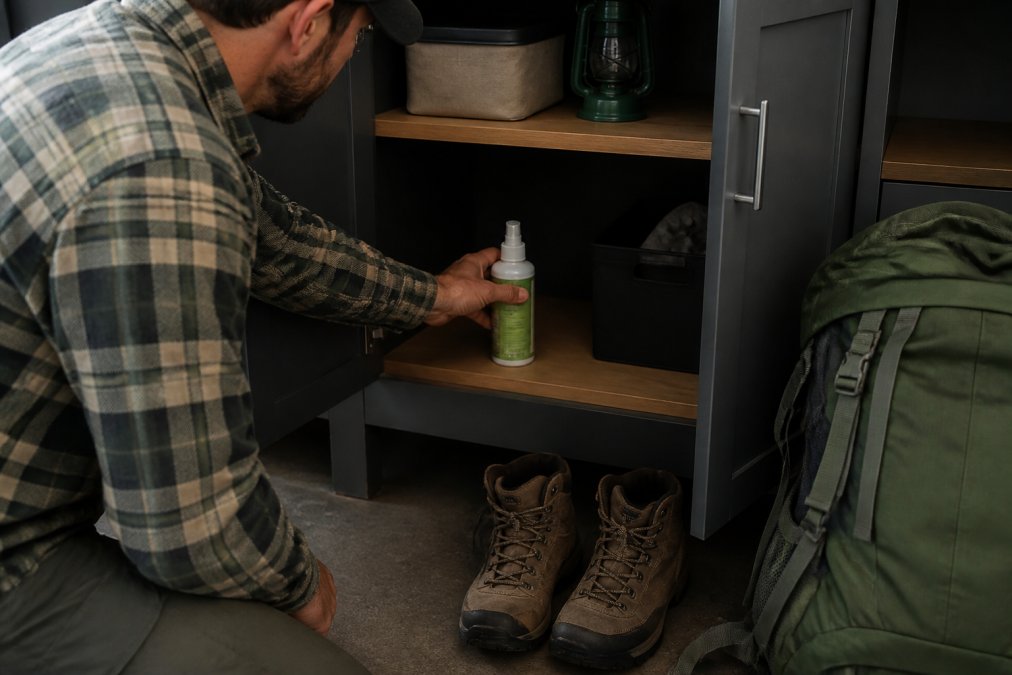
A common mistake is keeping repellent in the garage or the glovebox "so it's handy." In practice, that's the worst place for it. Temperature fluctuations accelerate chemical degradation, and a sealed vehicle in summer can reach temperatures that degrade active ingredients within a single season.
Practical storage rules:
- Keep bottles below room temperature where possible, never in direct sunlight
- Tighten caps and lids after every use to limit oxidation
- Store aerosols upright to protect the seal
- Keep repellent away from heaters, stoves, and vehicle cabins
Signs of Expired Bug Spray: Smell, Color, and Consistency
The clearest signs of expired bug spray are a change in smell, color, or consistency. A formulation that has degraded often smells sharper or more chemical than usual, turns cloudy or discolored, or sprays unevenly instead of as a fine mist.
Check these three things before you trust a bottle:
- Smell: A noticeably stronger, sour, or "off" odor points to chemical breakdown.
- Color: Separation, cloudiness, or a color shift from the original means the product integrity is compromised.
- Consistency: Gritty texture, clumping, or a weak, sputtering spray indicates the formula has broken down.
Aerosol cans add one more signal: if the can has lost pressure or sprays weakly, the propellant is failing and you won't get even coverage. Pump sprays that have thickened or separate when shaken are past their useful life.
Active Ingredients and Their Shelf Life: DEET, Picaridin, and Natural Options
Different active ingredients degrade at different rates, and the reason comes down to molecular structure. Understanding what actually happens inside the bottle explains why a DEET spray from three summers ago may still work while a botanical blend from last spring may not.
DEET (N,N-diethyl-meta-toluamide): DEET is a small, stable molecule that resists hydrolysis under normal conditions. Its main vulnerability is oxidation, exposure to oxygen in the headspace of a partially used bottle slowly converts it to less effective breakdown products. Heat accelerates this reaction, which is why a bottle stored in a hot car degrades faster than one kept in a cool closet. A well-stored DEET product can remain effective for several years past its printed date, though concentration may drift downward.
Picaridin (icaridin): Picaridin is a synthetic piperidine derivative with excellent hydrolytic stability. It resists breakdown in water-based and alcohol-based formulations alike. Its weak point is photodegradation, UV exposure through a clear bottle or a loose cap can slowly alter the molecule. Stored away from light and heat, picaridin products hold potency comparably to DEET.
Oil of lemon eucalyptus (OLE / PMD): The active component, para-menthane-3,8-diol, is a volatile terpenoid. Volatility is the enemy here: the same property that lets it evaporate from your skin to form a vapor barrier also means it slowly leaves the bottle. A loosely capped OLE product loses potency faster than a sealed one, and heat dramatically accelerates the loss. Expect meaningful decline within one to two seasons.
Botanical blends (citronella, geraniol, peppermint, etc.): These rely on volatile essential oil compounds that oxidize readily on contact with air and degrade under light. Shelf life is the shortest and most variable of any category, often a single season, sometimes less if storage is poor.
| Active Ingredient | Primary Degradation Mechanism | Typical Stability |
|---|---|---|
| DEET | Oxidation (heat-accelerated) | Longest of common actives; years if stored well |
| Picaridin | Photodegradation | Comparable to DEET; years if kept dark |
| Oil of lemon eucalyptus | Volatilization of PMD | Shorter; 1-2 seasons |
| Botanical blends | Oxidation + volatilization | Most variable; often one season |
For anyone who wants a botanical option without the guesswork, TickFree Outdoors offers repellent patches alongside its spray lineup, so you can match the format to how long you'll be outside.
Risks of Using Expired Tick Repellent and How to Test Potency at Home
The main risk of using expired tick repellent is a false sense of security. You apply it, assume you're covered, and spend hours in tick habitat with little or no real protection. That's how people end up finding a tick attached after a hike they thought they'd protected against.
There's no home lab test that measures remaining active-ingredient concentration, and any guide claiming otherwise is overselling. What you can do is a practical effectiveness check:
- Shake the bottle and confirm it mixes back to a uniform liquid.
- Spray a test patch and check for an even, fine mist rather than a sputter.
- Smell it and compare against a fresh bottle if you have one.
- Apply as directed and watch for the normal feel and coverage.
- If anything seems off, replace it. A new bottle costs far less than a tick-borne illness.
Proper Disposal of Expired Pesticides: Environmental Impact and Safe Methods
Repellents are pesticides under Canadian law, and that classification carries real disposal obligations. Pouring an old bottle down the drain or tossing it in the trash isn't just wasteful, it can contaminate soil, groundwater, and municipal water systems, and it may violate provincial waste regulations.
Why it matters: The active ingredients in tick repellent are designed to be biologically potent. DEET and picaridin can be toxic to aquatic invertebrates at low concentrations, and botanical actives like citronella and geraniol are similarly harmful to fish and amphibians. A single aerosol can dumped in a landfill can leach its contents over time. Aerosol propellants, often hydrocarbons or compressed gases, add a flammability and air-quality concern if punctured or incinerated.
The Canadian disposal framework:
- Federal: Health Canada regulates pesticide registration and labeling under the Pest Control Products Act. The label on your repellent carries legally binding disposal instructions, read them before doing anything else.
- Provincial and municipal: Household hazardous waste (HHW) programs are run at the provincial or municipal level. Most provinces operate designated HHW depots or periodic collection events where pesticides, aerosols, and other chemical products are accepted free of charge from residents.
- Retailer take-back: Some provinces operate extended producer responsibility (EPR) programs where retailers that sell pesticides must also accept them for safe disposal. Check whether your province participates.
Safe disposal steps:
For detailed rules, Health Canada's pesticide disposal and safety information is the authoritative starting point, and your provincial waste authority will list local drop-off sites and collection schedules.
Protecting Yourself from Tick-Borne Illness with Fresh Repellent
The challenge is simple: ticks don't care whether your repellent is fresh, and a degraded bottle gives you confidence you haven't earned.
Frequently Asked Questions
Does tick repellent go bad?
Yes, tick repellent can go bad. Most products have a shelf life of 2 to 3 years from the manufacturing date, though this varies by active ingredient. DEET-based repellents tend to last longer than natural options like oil of lemon eucalyptus. Once expired, the active ingredients break down, reducing effectiveness and leaving you vulnerable to tick bites. Always check the expiration date before heading outdoors.
What happens if I use expired bug repellent?
Using expired bug repellent means you may not get the full protection you expect. The active ingredients degrade over time, so the product might not repel ticks as effectively. This increases your risk of tick bites and potential exposure to Lyme disease and other tick-borne illnesses. If you only have expired repellent, apply it more frequently or choose a fresh product before entering wooded areas.
How should I store tick repellent to maximize its shelf life?
Store tick repellent in a cool, dry place away from direct sunlight and heat sources. Temperature fluctuations and UV exposure accelerate chemical degradation. Keep bottles tightly sealed to prevent oxidation. Avoid leaving repellent in a hot car or garage. Following these storage conditions helps maintain product integrity and extends the repellent's effectiveness for the full shelf life.
Does natural tick repellent expire faster than synthetic versions?
Natural tick repellents made with oil of lemon eucalyptus or other botanical ingredients often have a shorter shelf life than synthetic options like DEET or picaridin. The volatile compounds in natural repellents break down more quickly, especially when exposed to heat or light. Check expiration dates carefully and store natural products properly. Replace them sooner if you notice changes in smell, color, or consistency.