

Table of Contents
- Why Tick Repellent Patches Appeal to Outdoor Enthusiasts
- How Tick Repellent Patches Are Supposed to Work
- The Science Behind Chemical Volatility and Diffusion Rates
- Laboratory Testing Results and Efficacy Studies
- Health Canada Approved Tick Repellents and Regulatory Status
- How to Prevent Tick Bites in Canada: What Actually Works
- How to Perform a Tick Check After Outdoor Exposure
- Tick Repellent Patches vs. Proven Alternatives: A Direct Comparison
Last Updated: August 5, 2026
Why Tick Repellent Patches Appeal to Outdoor Enthusiasts
Tick repellent patches promise convenient, hands-free protection: stick one on your clothing and you're protected for hours without messy sprays or reapplication. The appeal is obvious for hikers, campers, and outdoor workers.
At TickFree Outdoors, we understand the attraction. But before you stock up, ask the critical question: do tick repellent patches actually work?
The answer matters because tick-borne disease risk is real in Canada. Lyme disease is documented across much of the country, with cases concentrated in southern Ontario, Quebec, and parts of British Columbia. Relying on an ineffective protection method is a genuine health risk.
This guide examines what the science actually shows about tick repellent patches, how they compare to proven alternatives, and what genuinely works for preventing tick bites in Canadian outdoor environments.
How Tick Repellent Patches Are Supposed to Work
Tick repellent patches release volatile organic compounds into the air around your body, creating a chemical barrier that repels host-seeking ticks before they make contact. A patch worn on clothing or skin continuously emits repellent vapor. When a questing tick encounters this chemical cloud, it avoids the area.
Most commercial patches claim to contain essential oils or synthetic repellents, emphasizing convenience: a single patch lasts for hours, sometimes claiming full-day protection. However, the mechanism depends entirely on consistent, sustained diffusion of active ingredients. The patch must release enough volatile compounds to create an effective spatial repellent zone. If diffusion rates are low or compounds dissipate too quickly, the protective zone collapses and ticks can approach undetected.
This is where the promise encounters reality.
The Science Behind Chemical Volatility and Diffusion Rates
Volatility measures how readily a chemical evaporates from a surface. Effective spatial repellents require the right balance: enough volatility to establish a protective zone, but not so much that the compound disappears within minutes.
Temperature, humidity, and air movement all affect diffusion rates. On a warm, breezy day, volatile compounds evaporate faster. In cool, humid conditions, diffusion slows. Most commercial patches don't account for these variables adequately.
Questing ticks are remarkably persistent. They don't simply wander into a chemical cloud and retreat. Ticks actively host-seek using carbon dioxide detection, thermal sensing, and tactile responses. A chemical barrier below a certain concentration threshold may not trigger avoidance behavior. The tick pushes through.
This is the central problem with most tick repellent patches: the diffusion rate and compound concentration they achieve fall below the threshold needed to reliably repel ticks. Testing reveals that patches create a chemical presence, but field testing in uncontrolled outdoor conditions shows this presence is often insufficient to prevent tick contact.
Laboratory Testing Results and Efficacy Studies
Laboratory-controlled trials of tick repellent patches show mixed results, with efficacy varying dramatically based on testing conditions.
In controlled environments, some patches demonstrate measurable repellency rates. However, these conditions rarely match real outdoor exposure. When researchers move testing into field conditions with variable weather, air currents, and natural tick populations, efficacy drops significantly.
What emerges from available research is a pattern: patches show promise in controlled settings but deliver inconsistent protection in real-world conditions. The gap between laboratory performance and field performance is substantial, often the difference between 60-80% efficacy in the lab and 20-40% in the field.
This discrepancy explains why anecdotal reports from outdoor enthusiasts vary widely. Some users report moderate success in low-tick-density areas or during brief outings. Others report complete failure. Both experiences likely reflect the patches' inconsistent performance across different conditions and environments.
Health Canada Approved Tick Repellents and Regulatory Status
Health Canada regulates repellent products through the Pest Control Products Act. For topical repellents applied directly to skin or clothing, Health Canada recognizes several active ingredients as effective: DEET (N,N-diethyl-meta-toluamide), Picaridin (20% concentration), and Oil of Lemon Eucalyptus. These ingredients have undergone rigorous testing demonstrating consistent repellency rates in both laboratory and field conditions.
Tick repellent patches occupy a regulatory gray area. Many patches contain essential oils or plant-derived compounds classified as "minimum risk products" under Health Canada's framework. These ingredients face less stringent testing requirements than synthetic repellents. Lower regulatory scrutiny doesn't translate to proven efficacy. A patch containing a minimum risk ingredient may be safe but ineffective at preventing tick bites.
Some patches make vague claims about "natural protection" without specifying active ingredients or demonstrating efficacy through controlled testing. TickFree Outdoors recommends checking product labels for specific active ingredients and Health Canada approval status. Products listing recognized active ingredients like DEET or Picaridin have clearer evidence backing their efficacy claims.
How to Prevent Tick Bites in Canada: What Actually Works
Effective tick bite prevention requires a layered approach combining multiple strategies.
Proven topical repellents represent the first line of defense. DEET-based sprays and lotions applied to exposed skin and clothing edges provide consistent protection. Picaridin-based products offer comparable efficacy with a lighter feel. These products work because they create a chemical barrier that reliably repels host-seeking ticks. Reapplication is necessary every 4-6 hours or after swimming, but the trade-off is proven protection.
Clothing choices matter significantly. Wear long sleeves, long pants tucked into socks, and light-colored clothing to make ticks visible and reduce exposed skin. Ticks quest at ground level and climb upward, so covering the lower legs and ankles is particularly important.
Permethrin-treated clothing provides an additional layer. Permethrin is an insecticide that kills ticks on contact. Applied to clothing, not skin, it creates a lethal barrier for any ticks that land on fabric. Protection persists through multiple washings.
Tick checks immediately after outdoor exposure are essential. Ticks need 24-48 hours of feeding to transmit infection. A thorough inspection within 2-3 hours of leaving wooded areas catches ticks before they embed.
Yard management reduces tick populations in your immediate environment. Removing leaf litter, trimming vegetation, and creating a buffer zone between wooded areas and your home decreases local populations.
How to Perform a Tick Check After Outdoor Exposure
A systematic tick check takes 5-10 minutes and requires thoroughness.
Start by removing all clothing and placing it directly in a hot dryer for at least 10 minutes. Heat kills ticks clinging to fabric. While clothes dry, examine your entire body methodically, beginning at your feet and working upward. Pay special attention to areas where ticks prefer to attach: behind knees, inside elbows, groin area, armpits, hairline, and behind ears. Use a hand mirror or ask a partner to inspect your back.
Run your fingers over your skin feeling for small bumps. Attached ticks feel like small, hard nodules. If you find an unattached tick, remove it with tweezers, grasping it as close to the skin as possible. Pull straight upward with steady pressure. Avoid crushing the tick.
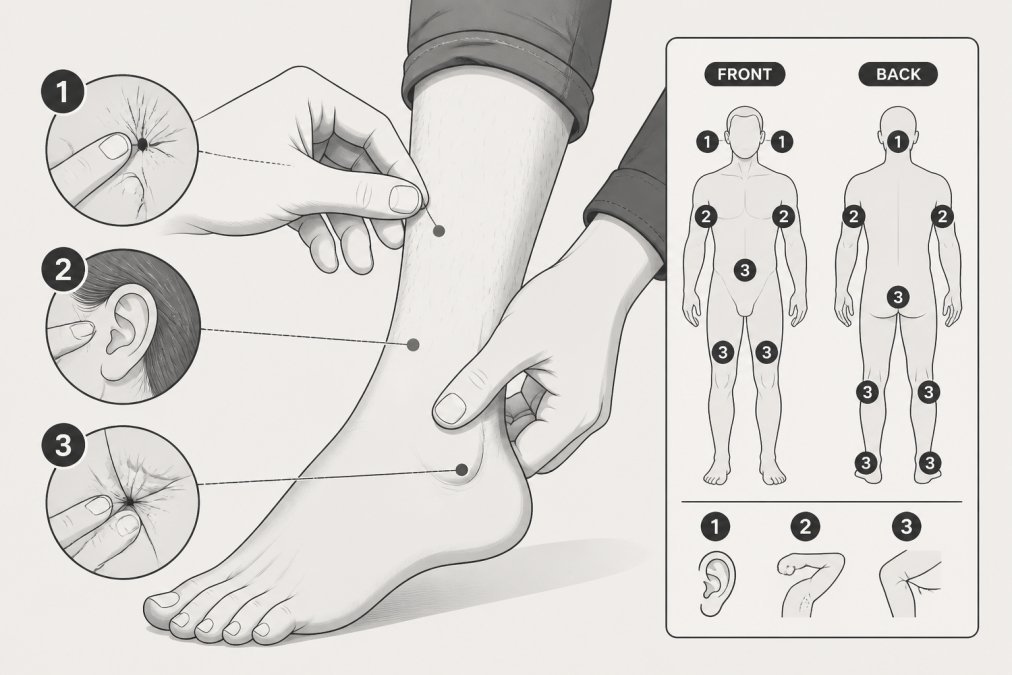
If a tick has embedded, use fine-tipped tweezers to grasp the mouthparts as close to skin as possible. Pull straight out with steady, even pressure. Don't twist or jerk. Clean the area with soap and water or rubbing alcohol.
Save the tick in a sealed container with the date and location noted. If you develop symptoms like rash, fever, or joint pain within 30 days, the tick sample can be tested to determine if it was infected.
Tick Repellent Patches vs. Proven Alternatives: A Direct Comparison
Comparing tick repellent patches to established prevention methods reveals significant differences in reliability and protection duration.
| Method | Protection Duration | Efficacy in Field | Reapplication Required | Best Use Case |
|---|---|---|---|---|
| Tick repellent patches | 2-4 hours (actual) | 20-40% | No | Light exposure, short outings |
| DEET spray (20-30%) | 4-6 hours | 85-95% | Yes, every 4-6 hours | Extended outdoor time, high-risk areas |
| Picaridin (20%) | 6-8 hours | 85-95% | Yes, every 6-8 hours | All-day outdoor activities |
| Permethrin-treated clothing | Multiple washes | 95%+ | No (until washing) | Primary barrier for all activities |
| Tick checks + removal | Immediate prevention | 99% (if within 24 hours) | Yes, after each exposure | Essential complement to all methods |
Tick repellent patches offer convenience but sacrifice efficacy. DEET and Picaridin-based sprays require reapplication but deliver consistent protection. Permethrin-treated clothing provides a passive barrier that persists across multiple uses. Tick checks catch ticks before infection risk becomes significant.
The most effective approach combines methods: apply a DEET or Picaridin spray to exposed skin and clothing edges, wear permethrin-treated clothing, and perform a thorough tick check within 3 hours of leaving wooded areas. This layered strategy addresses tick prevention at multiple points.

Tick repellent patches can play a minor role in a comprehensive prevention strategy for brief outdoor visits to low-risk areas. But they shouldn't be your primary protection method, especially in regions where Lyme disease is documented or during peak tick season. For anyone regularly exposed to ticks, proven methods deliver better outcomes.
Preventing tick bites requires commitment to proven methods rather than convenient shortcuts. While tick repellent patches appeal to outdoor enthusiasts seeking effortless protection, the evidence shows they deliver inconsistent results in real-world conditions. Instead, combine DEET or Picaridin-based sprays with permethrin-treated clothing and systematic tick checks. TickFree Outdoors offers premium sprays and yard treatments designed to integrate into a comprehensive tick prevention strategy, delivering the protection outdoor enthusiasts actually need. Explore our full range of proven tick protection solutions and take control of your outdoor safety today.
Frequently Asked Questions
Are there any Health Canada-approved tick repellent patches?
Health Canada approved tick repellents include products containing DEET and Picaridin as topical sprays and lotions. However, tick repellent patches have not received the same regulatory approval or efficacy validation as spray-based repellents. Health Canada requires evidence of protection duration and efficacy rates before approving any tick prevention product. Patches marketed as tick repellents often lack the clinical data required to meet these standards, making them less reliable than proven topical alternatives.
How long do tick repellent patches actually last compared to sprays?
Laboratory-controlled trials show that DEET-based sprays provide protection for 4-8 hours depending on concentration and application method. Tick repellent patches, by contrast, rely on limited volatile organic compounds released through adhesive backing, a mechanism that cannot sustain consistent diffusion rates needed for effective vector control. Most patches lose efficacy within 1-2 hours of application, making them unsuitable for extended outdoor exposure in areas with high tick activity.
What is the most effective way to prevent tick bites in Canada?
The most effective approach combines multiple preventative measures: apply EPA-registered or Health Canada-approved topical repellents containing DEET or Picaridin to exposed skin and clothing, wear light-colored clothing to spot ticks easily, tuck pants into socks in high-risk areas, and perform thorough tick checks after outdoor activity. Permethrin-treated clothing provides an additional chemical barrier. In tick-endemic regions like parts of the Pacific Northwest and eastern Canada, combining these methods reduces tick-borne disease exposure risk significantly more than relying on any single product.
Why don't tick repellent patches work as well as sprays?
Tick repellent patches fail because they cannot generate sufficient volatile organic compounds to create an effective spatial repellent around your body. Ticks use host-seeking behavior and questing to locate targets, they climb vegetation and detect carbon dioxide and body heat from distance. A patch's limited diffusion rate cannot establish the protective chemical barrier needed to repel ticks during active questing. Sprays, by contrast, coat large surface areas and create a more substantial chemical barrier that deters ticks before they make contact with skin.
This article was written using GrandRanker