

Table of Contents
- Deer Tick vs Dog Tick: The Key Physical Differences
- Where Each Tick Species Lives and When They Are Active
- How to Remove a Tick Safely From Skin or Fur
- Lyme Disease Symptoms in Humans and When to Seek Care
- Tick Bite Prevention Tips for Yards, Trails, and Pets
- Frequently Asked Questions
Last Updated: October 1, 2026
Deer Tick vs Dog Tick: The Key Physical Differences
Knowing how to identify a deer tick vs dog tick starts with one simple fact: deer ticks are smaller, darker, and carry Lyme disease, while dog ticks are bigger, brown with light markings, and rarely transmit it. This guide breaks down the physical clues, where each species lives, and what to do after a bite.
The deer tick, also called the blacklegged tick (Ixodes scapularis), is the main carrier of Lyme disease in Canada. The dog tick (Dermacentor variabilis) is far more common and far less dangerous. Size is your fastest clue, but the scutum (back shield) is the most reliable one.
Size, Color, and Markings at a Glance
An adult deer tick is roughly the size of a sesame seed. An adult dog tick can be two to three times larger, closer to a small watermelon seed.
Here is how they compare side by side:
| Feature | Deer Tick (Blacklegged) | Dog Tick |
|---|---|---|
| Size (unfed adult) | 2-3 mm | 5-6 mm |
| Size (unfed nymph) | ~1 mm (poppy seed) | ~2 mm |
| Color | Reddish-brown body, black legs | Brown with white mottling |
| Scutum (back shield) | Solid black, plain | Mottled white pattern |
| Mouthparts | Long proboscis | Short, stubby mouthparts |
| Anal groove | Curves in front of the anus | Curves behind the anus |
| Disease risk | Lyme disease, anaplasmosis, babesiosis | Rarely transmits disease; can cause tick paralysis in dogs |
The dorsal shield, called the scutum, is the clearest giveaway. On a deer tick it is plain and dark. On a dog tick it is decorated with white markings. If you only have a few seconds, look at the back.
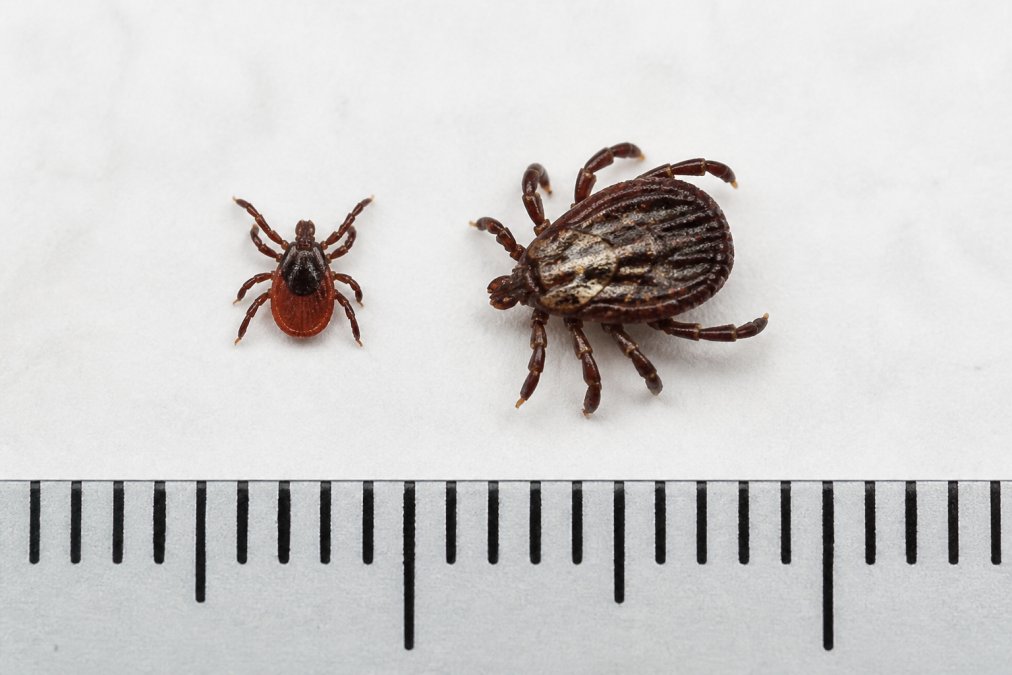
How to Tell Them Apart at Different Life Stages
Life stage changes everything about size, which is why so many people misidentify ticks.
Deer ticks pass through four stages: egg, larva, nymph, and adult. The nymph stage is the hardest to spot and the most likely to bite. A nymph is barely bigger than a poppy seed.
- Count the legs: larvae have six, nymphs and adults have eight
- Check the back shield: solid black = deer tick; white mottling = dog tick
- Look at mouthparts: long for deer tick, short for dog tick
- Compare size: sesame seed (deer tick adult) vs. watermelon seed (dog tick adult)
- Note the color: reddish-brown with black legs points to deer tick
Quick Decision Flow
If you have a tick in front of you right now, run this sequence:
- Is it smaller than a sesame seed and uniform dark? Likely a deer tick nymph, treat as high risk.
- Is it larger than a pencil eraser with white markings on the back? Likely a dog tick adult.
- Is the back shield solid black with no pattern? Deer tick.
- Is the back shield mottled white? Dog tick.
- Still unsure? Photograph it, save it in a sealed container, and submit the photo to a surveillance program.
Where Each Tick Species Lives and When They Are Active
Deer ticks thrive in moist, shaded areas: leaf litter, low shrubs, and the transition zone between lawn and forest. Dog ticks prefer open grass, trails, and fields, which is why dogs pick them up on walks.
Deer tick habitat:
- Leaf litter and decaying vegetation
- Low shrubs and forest edges
- Moist, humid microclimates
Dog tick habitat:
- Tall grass and open fields
- Trail edges and meadows
- Along fence lines and unkempt yards
Regional Seasonality Calendar
Most guides give a single national season. That is misleading, tick activity varies significantly by province and by life stage. Use this month-by-month guide to assess your immediate risk.
| Province / Region | Deer Tick Nymph Peak | Deer Tick Adult Peak | Dog Tick Peak |
|---|---|---|---|
| Ontario | May-July | October-November | May-August |
| Quebec | May-July | October-November | May-August |
| Nova Scotia | May-July | October-November | May-August |
| New Brunswick | May-July | October-November | May-August |
| Manitoba | May-June | September-October | May-July |
| British Columbia | April-June | September-November | April-July |
| Alberta / Saskatchewan | Limited established populations | Limited established populations | May-July |
What the Calendar Means in Practice
- April-June: Nymph season begins. Nymphs are poppy-seed sized and easy to miss. This is the highest-risk window for Lyme transmission because nymphs are small enough to feed unnoticed for 36-48 hours.
- July-August: Dog tick peak. Adult deer ticks are less active, but nymphs can persist into July in cooler regions.
- September-November: Adult deer tick season. Adults are larger and easier to spot, but they are also the most likely to carry pathogens.
- December-March: Deer ticks can be active on any mild day above freezing. Do not assume tick season is over just because the calendar says so.
This is the part most guides miss: deer ticks do not follow a strict seasonal shutdown. In coastal regions and mild winters, adult deer ticks can quest on any day the ground is not frozen and the temperature is above roughly 4°C.
How to Remove a Tick Safely From Skin or Fur
Follow these steps:
- Grab fine-tipped tweezers and grip the tick as close to the skin as possible
- Pull straight up with steady, even pressure. Do not jerk or twist
- Clean the bite area and your hands with antiseptic or soap and water
- Save the tick in a sealed bag or small container for later identification
- Note the date and location of the bite
- Watch the site for the next 30 days
Post-removal preservation matters more than most people realize. Keep the tick in a sealed container labeled with the date. If symptoms appear later, having the tick helps your healthcare provider.
Lyme Disease Symptoms in Humans and When to Seek Care
Lyme disease symptoms usually appear within 3 to 30 days of a bite (Lyme disease: For health professionals). The most recognizable sign is a bullseye rash, called erythema migrans. But not everyone gets it.
Watch for these signs:
- Expanding rash, sometimes ring-shaped
- Fever and chills
- Fatigue that does not improve with rest
- Muscle and joint aches
- Headache and neck stiffness
- Swollen lymph nodes
Tick Bite Prevention Tips for Yards, Trails, and Pets
Prevention is a layered approach. No single step is enough on its own.
On trails:
- Stay in the center of paths, away from tall grass and brush
- Wear light-colored clothing so ticks are easier to spot
- Tuck pants into socks
- Use a repellent spray on skin and clothing
In your yard:
- Keep grass short and clear leaf litter
- Create a gravel or woodchip border between lawn and woods
- Treat high-use areas with a yard spray
For pets:
- Do a full tick check after every walk
- Use repellent patches or sprays made for animals
- Check ears, paws, and the belly first
Frequently Asked Questions
How can I tell the difference between a deer tick and a dog tick?
Look at size and color first. An adult deer tick (blacklegged tick) is roughly 3 to 5 millimetres long and has a reddish-brown body with a dark dorsal shield behind the head. An adult dog tick is larger, around 5 to 8 millimetres, and has a mottled brown and white pattern on its back. Dog ticks also have shorter mouthparts and pale markings around the shield.
Which ticks in Canada carry Lyme disease?
The blacklegged tick (Ixodes scapularis) is the primary vector for Lyme disease in Canada, along with the western blacklegged tick in British Columbia. Dog ticks (Dermacentor variabilis) can carry other pathogens such as Rocky Mountain spotted fever bacteria, but they are not the main Lyme disease vector. Knowing which species bit you helps assess transmission risk.
What should I do if I find a tick attached to my skin?
Use fine-tipped tweezers or a tick removal tool to grasp the tick as close to the skin as possible. Pull straight up with steady pressure without twisting or crushing the body. Clean the bite area with antiseptic, then save the tick in a sealed container or photograph it for identification. If you develop a bullseye rash or flu-like symptoms, contact a healthcare provider.
Are dog ticks dangerous to humans or pets?
Dog ticks can transmit pathogens including Rocky Mountain spotted fever and tularemia, though they are not the main Lyme disease vector. Pets are especially vulnerable because dog ticks commonly attach around ears, between toes, and in skin folds. Regular tick checks after outdoor time and preventive products reduce the risk for both people and animals.
Ticks are small, easy to miss, and getting more common across the country. The good news is that a few habits, plus the right gear, cut your risk fast. TickFree Outdoors carries premium sprays, repellent patches, and yard treatments to protect people, pets, and your outdoor spaces, with fast worldwide shipping, great prices, and premium customer service. Get started with TickFree Outdoors and keep every adventure tick-free.